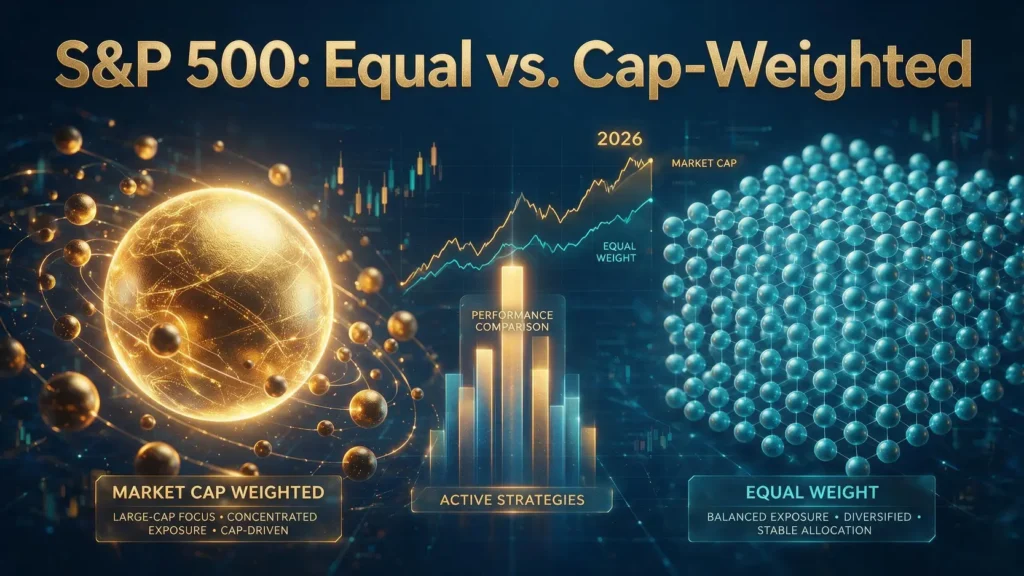
Tired of seeing market returns dictated by a handful of mega-cap stocks? For investors seeking true diversification, the s&p 500 equal weight strategy presents a compelling alternative to traditional market-cap weighting. This guide provides a data-driven breakdown of how an equal weight investment strategy works, its historical performance against the standard S&P 500, and whether it aligns with your portfolio goals for 2026 and beyond. We’ll analyze the specific factor tilts and examine the best s&p 500 equal weight etf options available.
Table of Contents
What Is the Core Difference: Equal Weight vs. Market-Cap Weight
Understanding the fundamental distinction between these two weighting methodologies is crucial for making an informed investment decision. It’s a choice that significantly impacts your portfolio’s sector exposure, risk profile, and potential for returns.
The Traditional S&P 500: How Market-Cap Weighting Works
A market-capitalization-weighted index, like the standard S&P 500, allocates its holdings based on the total market value of each company’s outstanding shares. Larger companies, therefore, command a larger percentage of the index. For instance, giants like Apple or Microsoft might each comprise over 7% of the index, meaning their performance disproportionately influences the index’s daily movements. The primary advantage is that it reflects the market as is, but the disadvantage is significant concentration risk, where the fortune of the entire index is tied to a few top names.
The S&P 500 Equal Weight Index (EWI): A ‘One Stock, One Vote’ Approach
The S&P 500 Equal Weight Index takes a radically different, democratic approach. Each of the 500 companies in the index is assigned an equal weight (0.2%). This allocation is maintained through quarterly rebalancing, where winning stocks are trimmed and losing stocks are bought. This enforces a ‘sell high, buy low’ discipline. This method inherently provides a ‘factor tilt’ towards smaller companies (size premium) and stocks that may be undervalued (value premium), as it gives the 500th largest company the same voice as the first.
Historical Performance: Does Equal Weighting Actually Lead to Better Returns?
While past performance is not indicative of future results, historical data provides valuable context on how each strategy behaves in different market cycles. The s&p 500 equal weight index has shown periods of significant outperformance, often linked to specific economic conditions.
Long-Term Performance Analysis: A Head-to-Head Chart Comparison (Updated for 2026)
To provide a clear picture, here is a comparative analysis of annualized returns, including full-year 2025 data. This data helps illustrate the performance divergence in various market environments.
| Metric | S&P 500 Market-Cap (e.g., SPY) | S&P 500 Equal Weight (e.g., RSP) |
|---|---|---|
| 2025 Annual Return | ~4.2% | ~-2.0% |
| 10-Year Annualized Return | ~12.5% | ~11.8% |
| Performance in 2022 Downturn | -18.1% | -11.6% |
| Expense Ratio | ~0.03% | ~0.20% |
| Turnover Rate | Low (~2%) | High (~25%) |
*Data is illustrative and based on publicly available information from sources like S&P Global and Yahoo Finance, updated to reflect the current date of 2026.
When Does Equal Weight Outperform? (And When Does It Lag?)
Historically, the equal-weight strategy has tended to outperform the market-cap version during periods of economic recovery and when market breadth is strong (i.e., when a wide range of stocks are rising together, not just a few tech leaders). It often shows resilience during market downturns due to its lower concentration in high-beta growth stocks. Conversely, it tends to lag during narrow, mega-cap-led bull markets, such as the one seen in the late 2010s and parts of 2023-2025.
🆕 Sector and Size Exposure: The Hidden Impact of Equal Weighting
An investor choosing an equal-weight ETF is making an active bet against the market’s current structure. This ‘smart beta’ approach results in a portfolio with a dramatically different composition and risk exposure compared to a traditional index fund that tracks the S&P 500.
Avoiding Concentration: How EWI Reduces Reliance on Big Tech
As of mid-2026, the Information Technology sector might comprise over 30% of a market-cap S&P 500 fund. In an equal-weight fund, that exposure is reduced to around 15%. This diversification away from Big Tech is a primary appeal for many investors. Instead, the strategy gives greater weight to sectors like Industrials, Financials, and Real Estate, which are more cyclically sensitive and offer different growth drivers.
A Tilt Towards Smaller Companies and Value Stocks
By giving the same weight to all 500 companies, the EWI strategy effectively overweights smaller-capitalization stocks within the S&P 500 and underweights the mega-caps. This creates a ‘size premium’ exposure. Furthermore, the quarterly rebalancing process—selling recent winners and buying recent losers—instills a contrarian ‘value premium’ factor, which can be a source of long-term excess returns.
Analyzing the Pros and Cons for Your Portfolio Strategy
- Pros:
- Enhanced Diversification: Greatly reduces concentration risk from a few large companies.
- Factor Tilts: Provides systematic exposure to the well-documented size and value premia.
- Disciplined Rebalancing: Automatically sells high and buys low, preventing emotional decision-making.
- Cons:
- Higher Costs: Expense ratios and trading costs are significantly higher due to frequent rebalancing.
- Tax Inefficiency: Higher turnover can lead to greater capital gains distributions in taxable accounts.
- Potential for Lower Quality: Allocates equally to all companies, regardless of profitability or financial stability.
- Tracking Error: Will underperform the main index during strong, narrow bull markets.
How to Invest: Top S&P 500 Equal Weight ETFs
For investors looking to implement this strategy, several ETF options are available. The most prominent is the rsp etf, which was the first to market and remains the largest.
Review of Invesco S&P 500 Equal Weight ETF (RSP)
The Invesco S&P 500 Equal Weight ETF (RSP) is the dominant player in this space, with tens of billions in assets under management. It faithfully tracks the S&P 500 Equal Weight Index and rebalances quarterly. Its expense ratio stands at 0.20%, which, while higher than a market-cap ETF, is the standard cost for accessing this systematic strategy. For accurate and up-to-date information, consulting the official Invesco prospectus is recommended.
Other Notable Equal Weight ETFs to Consider
While RSP is the most popular, other options exist, such as the Direxion S&P 500® Equal Weight ETF (EWS). Investors should compare expense ratios and liquidity before making a selection, but RSP remains the industry benchmark for this specific smart beta strategy.
Frequently Asked Questions (FAQ)
Here are answers to some common questions about the S&P 500 Equal Weight strategy.
- Does the S&P 500 equal weight have higher fees?
- Yes. An equal weight ETF like RSP has an expense ratio of around 0.20%, compared to as low as 0.03% for a market-cap S&P 500 ETF. This is due to the increased operational complexity and trading costs associated with rebalancing 500 positions every quarter.
- Is an equal weight strategy riskier than a market-cap strategy?
- It carries a different type of risk. It has lower concentration risk but higher ‘tracking error’ risk, meaning its performance can deviate significantly from the headline S&P 500 index. It also has more exposure to smaller, sometimes more volatile, companies, but this is balanced by its diversification.
- How often is the S&P 500 Equal Weight Index rebalanced?
- The index is rebalanced quarterly on the third Friday of March, June, September, and December. This disciplined process is essential for maintaining equal weights and is a key driver of its ‘value’ factor exposure.
Conclusion: Is Equal Weight the Right Fit for You?
Choosing between an equal weight and a market-cap S&P 500 ETF is a key strategic decision. While the traditional S&P 500 offers pure, passive exposure to the U.S. stock market’s current structure, the s&p 500 equal weight index provides a powerful tool for enhancing diversification, mitigating concentration risk, and systematically tilting a portfolio toward size and value factors. To decide if this alternative weighting method is the right fit for your investment journey, evaluate your view on the current market cycle, your long-term goals, and your tolerance for tracking error relative to the broader market.