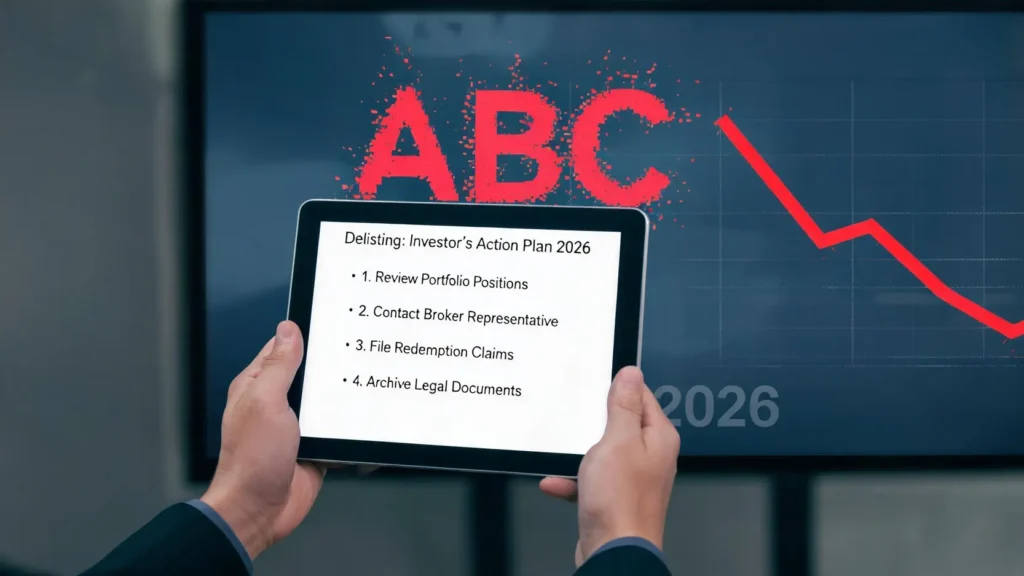
Receiving a notification that a stock you own is being delisted can be alarming. This guide breaks down exactly what delisting is, why it happens, and most importantly, what it means for your investment portfolio. We’ll cover everything from the core process and the impact on your shares to the immediate, actionable steps you should take to protect your capital. This isn’t just a definition; it’s an investor’s action plan for navigating the delisting process.
Table of Contents
Understanding Delisting: The Core Concepts
Delisting is the formal removal of a company’s listed security from a stock exchange. Once a stock is delisted, it can no longer be traded on that specific exchange, such as the New York Stock Exchange (NYSE) or NASDAQ. This doesn’t mean the company has vanished, but it fundamentally changes how and where investors can trade its shares.
The Primary Meaning: Removing a Security from a Stock Exchange
When a company first offers shares to the public, it goes through a rigorous “listing” process to be accepted onto a major exchange. Delisting is the reverse of this process. The security is struck from the exchange’s roster, typically moving to over-the-counter (OTC) markets, which are less regulated and have lower liquidity. The process is formally initiated through filings with the Securities and Exchange Commission (SEC), most notably Form 25.
Voluntary vs. Involuntary Delisting: Key Differences and Motivations
A delisting event falls into one of two categories, each with vastly different implications for shareholders:
- Voluntary Delisting: This is a strategic decision made by the company’s management. Common reasons include going private through a buyout, merging with another company, or looking to reduce the significant regulatory and administrative costs associated with being a publicly traded entity. While it can cause short-term uncertainty, a voluntary delisting, especially in a merger or acquisition scenario, often involves a buyout offer for existing shares.
- Involuntary Delisting: This is a forced removal by the stock exchange because the company has failed to meet the required listing standards. This is typically a major red flag, signaling severe financial distress or governance issues. For investors, this type of delisting is far more concerning as it often precedes a steep decline in share value.
Common Reasons a Stock Gets Delisted
Exchanges enforce strict rules to ensure market integrity and protect investors. When a company breaches these rules, it risks an involuntary delisting. Here are the most common triggers.
Failure to Meet Exchange Requirements (e.g., Minimum Share Price, Market Cap)
Major exchanges have clear, quantitative continued listing standards. A company can be delisted if it fails to maintain these for a sustained period. According to NASDAQ’s listing rules, for instance, a company must maintain a minimum bid price of $1.00 per share. Falling below this for 30 consecutive business days triggers a compliance warning and starts the clock on a potential delisting. The table below outlines some of the key requirements for 2026.
| Metric | NASDAQ (Select Continued Listing Standards) | NYSE (Select Continued Listing Standards) |
|---|---|---|
| Minimum Average Closing Price | $1.00 over 30 consecutive trading days | $1.00 over a 30 trading-day period |
| Market Capitalization | Varies by market tier (e.g., $50 million for Global Select) | Average global market cap of at least $50 million over 30 trading days |
| Total Stockholders’ Equity | Varies (e.g., $10 million for Global Select) | At least $50 million |
| Publicly Held Shares | Varies (e.g., 1.1 million for Global Market) | Minimum 1.1 million |
Note: These are simplified examples. Always refer to the official and complete listing standards from the respective exchanges for definitive information.
Bankruptcy and Severe Financial Distress
A company filing for Chapter 7 or Chapter 11 bankruptcy is almost certain to be delisted. Bankruptcy proceedings create extreme uncertainty about the value of the company’s equity, making it unsuitable for trading on a major exchange. Shareholders of a bankrupted company are often last in line for repayment, if any, after debtors and bondholders.
Strategic Moves: Mergers, Acquisitions, or Going Private
In a merger or acquisition, the acquired company’s stock is typically delisted as it is absorbed into the purchasing entity. Shareholders may receive cash, shares in the new combined company, or a mix of both. Similarly, a company may choose to “go private” by buying back all of its publicly traded shares, a process that also results in delisting.
What Happens to My Shares After a Stock Is Delisted?
The most pressing question for any investor is what happens to their investment. While your shares don’t disappear, their value and your ability to trade them are significantly impacted.
Can I Still Sell My Shares? Introduction to OTC Markets
Yes, you can typically still sell your shares, but not on the major exchange. They will likely be traded on the Over-the-Counter (OTC) markets, such as the OTC Bulletin Board (OTCBB) or Pink Sheets. These are quotation services, not exchanges, with different tiers of transparency and reporting standards. Your broker should handle the transition, but trading on OTC markets carries higher risks, including lower liquidity and wider bid-ask spreads, meaning it can be harder to sell your shares at a fair price.
The Impact on Share Value and Liquidity
An involuntary delisting is almost always bad news for the share price. The loss of institutional investment, reduced analyst coverage, and the signal of financial trouble can lead to a sharp sell-off. Liquidity—the ease with which you can buy or sell shares—dries up significantly on OTC markets. With fewer buyers and sellers, a single large trade can cause extreme price swings, a phenomenon known as high volatility.
Can a Delisted Company Be Relisted?
It is possible, but it is a difficult and uncommon process. The company must resolve all the issues that led to the involuntary delisting and then re-apply to the exchange, meeting all the stringent initial listing requirements from scratch. This is a long road that requires a significant corporate turnaround.
Beyond the Stock Market: Other Important Meanings of Delisting
The term “delisting” is also used in important regulatory contexts outside of finance. Understanding these helps provide a complete picture of the concept.
Environmental Context: Delisting Hazardous Waste (EPA)
In environmental regulation, delisting refers to the U.S. Environmental Protection Agency’s (EPA) process for removing a waste stream from its list of hazardous materials. As documented by the EPA, a facility can petition to have a specific waste delisted if it can prove that the material no longer poses a sufficient threat to human health or the environment.
Conservation Context: Delisting an Endangered Species (FWS)
In conservation, a species can be delisted from the Endangered Species Act (ESA). This celebrated event occurs when a species has recovered to the point where it no longer needs the ESA’s protections to survive. The U.S. Fish & Wildlife Service (FWS) manages this process, which involves extensive scientific review and public comment to ensure the species’ long-term stability.
Frequently Asked Questions About Stock Delisting
Is delisting always bad for a company?
Not necessarily. While an involuntary delisting due to non-compliance is a strong negative signal, a voluntary delisting can be a strategic positive. A company going private or being acquired in a merger often does so at a premium to its trading price, which can be beneficial for shareholders.
How do I find out if one of my stocks is being delisted?
The company is required to issue a press release and file official forms (like Form 25 or 8-K) with the SEC. Major financial news outlets will also report on it. Additionally, the exchange will issue a public notice. Your brokerage firm should also notify you if you hold the affected stock.
What is the difference between delisting and a trading halt?
A trading halt is a temporary suspension of trading for a specific stock, often lasting minutes or hours, typically in anticipation of major news. Delisting is the permanent removal of the stock from the exchange. A halt is a pause; a delisting is a removal.
Conclusion
In conclusion, delisting is the formal removal of a security from a public exchange. For investors, understanding what delisting is and the specific reasons behind it is crucial for making informed decisions. While it often signals trouble, particularly in an involuntary scenario, it’s essential to assess the specific situation—from the cause of the delisting to the new trading venue—before deciding on your next steps. An immediate, calm analysis of the facts is the best defense against portfolio damage.