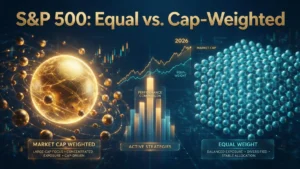
For investors seeking to outperform traditional market-cap weighted indexes, the world of ‘smart beta’ offers compelling alternatives. This guide explores the rafi fundamental index etf, a popular strategy that weights companies by economic size rather than stock price. This fundamental weighting strategy offers a different approach compared to standard ETFs. Discover how they work, their pros and cons, and if this smart beta etf deserves a place in your portfolio.
Table of Contents
What is the RAFI Fundamental Index Strategy?
The RAFI (Research Affiliates Fundamental Index) strategy is an investment approach that moves away from the conventional market-capitalization method of weighting stocks in an index. Instead of giving the largest companies by stock market value the biggest weight, RAFI focuses on the fundamental economic footprint of a company. This methodology was developed by Rob Arnott of Research Affiliates with the goal of creating a more objective measure of a company’s size.
The Core Concept: Breaking Free from Market-Cap Weighting
In a traditional index like the S&P 500, a company’s weight is determined by its market capitalization (stock price multiplied by the number of outstanding shares). This means that as a stock’s price goes up, its influence on the index increases, regardless of the company’s actual economic health. The RAFI approach argues this can lead to over-exposure to overvalued stocks and under-exposure to undervalued ones. By using fundamental metrics, it aims to anchor the portfolio to the real economy.
The Four Key Factors: How Companies Are Weighed
The RAFI methodology assesses a company’s size based on four equally-weighted fundamental factors:
- Sales: Averaged over the last five years to smooth out business cycles.
- Cash Flow: Also averaged over the last five years, representing the cash generated by the business.
- Dividends: The total dividends paid, averaged over five years, including any stock buybacks.
- Book Value: The net asset value of the company at the most recent fiscal year-end.
Companies are then ranked based on a composite of these four metrics to determine their weight in the index.
How It Aims to Deliver Excess Returns vs. Traditional Indices
The core thesis of the rafi fundamental index etf is that market prices often deviate from a company’s true intrinsic value. By systematically rebalancing back to weights based on fundamental size, the strategy inherently sells companies that have become expensive (their market cap has outpaced their fundamentals) and buys companies that have become cheap (their fundamentals are strong relative to their market cap). This disciplined, contrarian approach is designed to generate long-term excess returns over market-cap-weighted benchmarks.
RAFI ETFs vs. Traditional S&P 500 ETFs: A Head-to-Head Comparison
To understand the practical difference, let’s compare leading RAFI ETFs with a standard S&P 500 ETF. The key distinction lies in how they select and weight their holdings, which leads to different sector exposures and performance characteristics.
| Metric | RAFI ETF Example (PRF/FNDX) | S&P 500 ETF Example (SPY) |
|---|---|---|
| Weighting Methodology | Based on four fundamental factors: sales, cash flow, dividends, and book value. Aims to reflect a company’s economic footprint. | Market-Capitalization Weighted. The largest companies by market value have the highest allocation. |
| Sector Tilts | Often has a natural tilt towards value sectors like Financials, Energy, and Industrials, which may have large economic footprints but lower market valuations. | Typically dominated by the largest growth and technology companies, as seen with significant weights in Information Technology. |
| Potential Performance | May outperform during value-driven market cycles and when market-cap bubbles deflate. Can underperform during strong growth-led bull markets. | Performs strongly when large-cap growth stocks, particularly in the tech sector, are leading the market. |
| Expense Ratio | Generally higher due to the more complex indexing methodology. (e.g., PRF: ~0.39%, FNDX: ~0.25%) | Typically very low due to the simplicity of tracking the index. (e.g., SPY: ~0.09%) |
Leading RAFI Fundamental Index ETFs to Consider
Several ETF providers offer products based on the RAFI methodology. Here are some of the most prominent options for investors looking to access this strategy.
Invesco RAFI US 1000 ETF (PRF)
PRF is one of the original and largest RAFI ETFs. It tracks the FTSE RAFI US 1000 Index, which is composed of the 1,000 largest US companies based on the four fundamental metrics. It provides broad exposure to large-cap U.S. equities with a distinct value tilt compared to the S&P 500. Its portfolio is often overweight in financials and energy and underweight in technology.
Schwab Fundamental U.S. Large Company Index ETF (FNDX)
FNDX is another popular choice that tracks the Russell RAFI™ US Large Company Index. While its methodology is similar to PRF’s, there can be slight differences in index construction and holdings. FNDX is known for its competitive expense ratio within the smart beta space, making it an attractive option for cost-conscious investors seeking a fundamental-based strategy.
Exploring International and Emerging Market RAFI Options
The RAFI strategy is not limited to the United States. Investors can also find ETFs that apply the same fundamental weighting methodology to international developed markets and emerging markets. These funds offer a way to diversify globally while avoiding the potential pitfalls of market-cap concentration in foreign indices.
The Pros and Cons of Investing in RAFI ETFs
Like any investment strategy, the RAFI fundamental approach has its own set of potential benefits and drawbacks that investors should carefully consider.
Potential Advantages: Value Exposure and Contrarian Approach
The primary advantage is its disciplined, non-market-cap approach, which provides a systematic value tilt. By severing the link between a stock’s price and its weight in the portfolio, RAFI ETFs avoid chasing market trends and overloading on potentially inflated assets. This contrarian rebalancing may enhance long-term returns.
Potential Disadvantages: Higher Expense Ratios and Tracking Error
RAFI ETFs typically have higher expense ratios than simple market-cap-weighted funds like SPY or VOO. This is due to the more complex methodology and rebalancing process. Additionally, their performance will naturally differ from the S&P 500, a phenomenon known as tracking error. During periods when large-cap growth stocks dominate, these funds are likely to underperform the broader market.
Understanding the Risks and When They Might Underperform
The main risk is cyclical underperformance. In markets heavily driven by momentum and growth stocks (such as the tech boom), a value-oriented strategy like RAFI can lag significantly. Investors need to have a long-term perspective and understand that this strategy’s success is not guaranteed in every market environment.
How to Add RAFI ETFs to Your Investment Portfolio
Incorporating a rafi fundamental index etf into your portfolio requires a thoughtful approach to ensure it aligns with your financial objectives.
Step 1: Determining if RAFI Aligns With Your Investment Goals
First, assess if the strategy fits your philosophy. If you believe that markets can be inefficient and that anchoring to fundamentals provides a long-term edge, RAFI could be a suitable choice. It is best suited for investors with a long time horizon who can withstand periods of underperformance relative to traditional benchmarks.
Step 2: Finding RAFI ETFs on Major Brokerage Platforms
Finding these ETFs is straightforward. Simply use the ticker symbol—such as PRF for the Invesco ETF or FNDX for the Schwab ETF—on any major brokerage platform. You can analyze their specific holdings, expense ratios, and historical performance data directly through your broker.
Step 3: Deciding on Your Portfolio Allocation
You can use a RAFI ETF as a core holding to replace or complement a traditional market-cap index fund. Alternatively, it can be used as a satellite holding to add a specific value tilt to an already diversified portfolio. The allocation percentage will depend on your individual risk tolerance and overall investment strategy.
Frequently Asked Questions (FAQ)
- What is the main difference between RAFI and a standard index fund?
- The main difference is the weighting methodology. A standard index fund (like an S&P 500 ETF) uses market-capitalization weighting, meaning companies with higher stock market values have a larger weight. A RAFI fund uses four fundamental metrics (sales, cash flow, dividends, book value) to determine a company’s weight, reflecting its economic size.
- Are RAFI ETFs considered active or passive investments?
- They are generally considered a hybrid, often falling under the category of ‘smart beta’ or strategic beta. While they are passive in that they follow a predefined, rules-based index, the index itself is constructed with an active view—that fundamentals are a better measure of a company’s size than market price.
- Who created the RAFI Fundamental Index methodology?
- The RAFI methodology was created by Rob Arnott, founder of the investment management firm Research Affiliates. His research challenged the dominance of market-cap weighting and helped popularize fundamental indexing and the broader smart beta movement.
Conclusion: A Strategic Alternative for Modern Portfolios
In summary, RAFI Fundamental Index ETFs offer a rules-based, non-market-cap-weighted approach to investing, potentially providing a valuable diversification tool, a consistent value tilt, and long-term return advantages. By breaking the link between a stock’s price and its portfolio weight, this strategy aims to avoid the performance drag of owning overvalued stocks. By understanding their unique methodology and weighing the pros and cons, you can make an informed decision about whether this innovative strategy fits your financial objectives. Always conduct thorough research on specific tickers like PRF or FNDX before investing.