
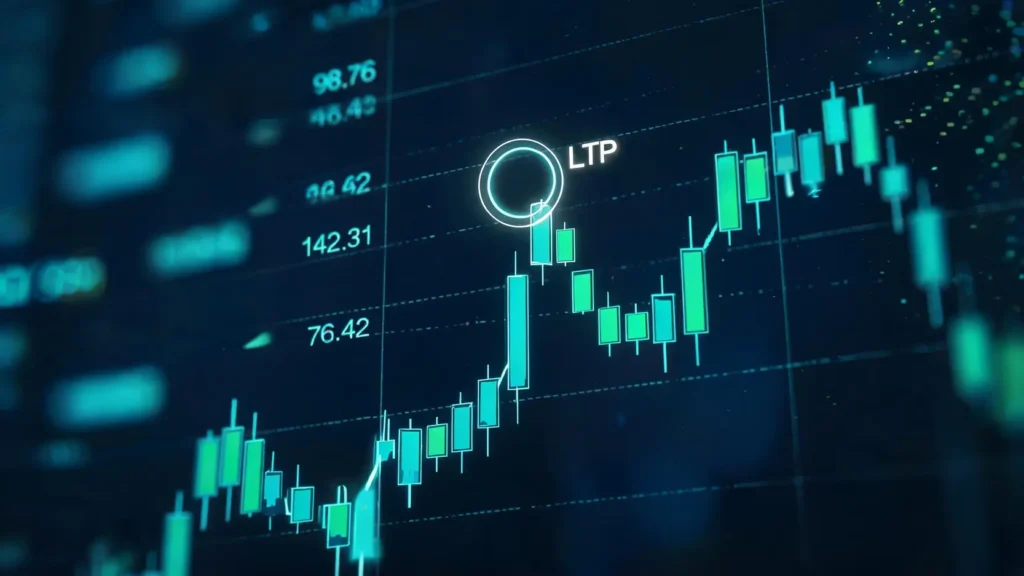
When you analyze a stock, you’re faced with multiple prices: the bid, the ask, the open, the close, and the Last Traded Price (LTP). For active traders, understanding what LTP means in the share market is critical. This real-time metric is more than just a number; it’s a direct signal of the market’s current valuation. This guide explains exactly what the LTP is, how it differs from other key prices, and how you can leverage it to make more informed and timely trading decisions.
目录
LTP Meaning: Defining the Last Traded Price
The Last Traded Price (LTP) is the most recent price at which a stock was bought and sold on an exchange. It represents the exact value of the last completed transaction between a buyer and a seller. Every time a trade occurs, the LTP is updated, making it one of the most dynamic indicators of a stock’s present market activity.
What LTP Represents: The Most Recent Transaction Price
The LTP is a historical fact, even if it’s only milliseconds old. It confirms that a buyer and a seller agreed on a specific price and executed a trade. This agreement point is crucial as it reflects the immediate consensus of value in the market. Unlike bid and ask prices, which represent potential future trades, the LTP is the price of a consummated deal.
Why LTP is a Real-Time Indicator of a Stock’s Value
In a liquid market, the LTP provides an up-to-the-second snapshot of a stock’s demand and supply dynamics. Its constant fluctuation shows how market sentiment is shifting throughout the trading day. For intraday traders, this real-time data is indispensable for identifying trends, setting entry points, and executing stop-loss orders.
How is the Last Traded Price (LTP) Calculated?
The LTP isn’t calculated using a formula; it is determined by the market’s core mechanism—the matching of buy and sell orders. Understanding this process is key to interpreting what LTP in the share market truly signifies.
The Interaction of Buy and Sell Orders
An exchange’s trading engine continuously maintains an order book for every listed stock. This book lists all ‘bid’ prices (what buyers are willing to pay) and ‘ask’ prices (what sellers are willing to accept). A trade occurs—and a new LTP is established—when one of two things happens:
- A buyer places an order at the current lowest ask price.
- A seller places an order at the current highest bid price.
The price at which this transaction is executed becomes the new Last Traded Price.
The Impact of Trading Volume on LTP Fluctuations
Trading volume—the number of shares being traded—plays a vital role in the significance of the LTP. High volume indicates strong participation and means the LTP is a robust indicator of the stock’s current value. Conversely, in a low-volume or illiquid stock, the LTP can be misleading as it might be based on a single, small trade and not reflective of the broader market interest.
The Key Difference: LTP vs. Closing Price
Traders often confuse the Last Traded Price with the Closing Price, but they serve different functions. While the LTP can be the final price of the day, the official Closing Price is often calculated differently by exchanges like the NYSE or NASDAQ.
| Metric | Last Traded Price (LTP) | Closing Price |
|---|---|---|
| Definition | The price of the very last trade during regular trading hours. | Typically a volume-weighted average of trades during the final minutes of the trading day. |
| Timing | Updates in real-time with every trade. | Calculated once at the end of the trading day. |
| Use Case | Essential for intraday trading decisions and real-time tracking. | Used for daily performance charts, historical analysis, and mutual fund NAV calculations. |
| Nature | A single, specific transaction price. | An averaged, representative price for the day’s end. |
LTP: The Last Price During Trading Hours
The LTP is simply the price of the final executed trade before the market closes. It’s a raw data point reflecting the very last moment of market activity.
Closing Price: The Final Price at the End of the Day
Most major exchanges calculate the official Closing Price using a weighted average of transactions that occur in the last few minutes or seconds of the trading session. This method provides a more stable and representative price, smoothing out any extreme volatility that might occur in the final moments.
Using LTP in Your Trading Strategy
Understanding the LTP is only useful if you can apply it. The Last Traded Price is a foundational element for technical analysis and strategy execution, particularly for short-term traders.
Making Intraday Trading Decisions with LTP
Intraday traders rely on the LTP to:
- Identify momentum: A rapidly increasing LTP on high volume can signal a bullish breakout.
- Set entry and exit points: Traders often set buy orders just above a key resistance level that the LTP has just crossed, or sell when the LTP falls below a support level.
- Place stop-loss orders: A stop-loss is typically set at a specific price level below the purchase price. The LTP is the trigger that executes this order to limit potential losses.
Combining LTP with Other Technical Indicators
Relying solely on LTP is a flawed strategy. For a more robust analysis, it must be combined with other indicators:
- Volume: A rising LTP with high volume is a much stronger bullish signal than a rising LTP on low volume.
- Moving Averages: Comparing the LTP to short-term (e.g., 9-day) and long-term (e.g., 50-day) moving averages helps identify the prevailing trend.
- VWAP (Volume-Weighted Average Price): If the LTP is above the VWAP, it suggests bullish sentiment for the day. If it’s below, bearish sentiment may be in control.
Common Misconceptions About LTP
To truly master your understanding of the Last Traded Price, it’s crucial to be aware of what it is *not*. Many new traders fall into common traps by misinterpreting this data point.
Is LTP the Same as the ‘Bid’ or ‘Ask’ Price?
No. This is the most critical distinction. The LTP is a *past* event—the price of the last completed trade. The ‘Bid’ price is the highest price a buyer is *currently willing to pay*, and the ‘Ask’ price is the lowest price a seller is *currently willing to accept*. You buy at the ask and sell at the bid. The LTP is simply a report of the last match between a buyer and a seller.
The Limitations of Relying Solely on LTP Data
The LTP is a powerful indicator, but it has its limits. It does not guarantee you can buy or sell at that price. In a fast-moving or illiquid market, the price can change significantly between the moment you see the LTP and the moment your order is executed—a phenomenon known as ‘slippage’. Furthermore, the LTP doesn’t account for orders in the ‘dark pools’ or after-hours trading, which can also influence the next day’s opening price.
Conclusion: The Role of LTP in Modern Trading
Understanding what LTP means is fundamental for anyone involved in the share market. As the Last Traded Price, it provides the most current snapshot of a stock’s market value, reflecting the point where supply and demand have just met. By using it correctly alongside other metrics like volume, closing price, and technical indicators, you can move beyond simply watching prices and start making strategically sound trading decisions.
Frequently Asked Questions (FAQ)
Why does the LTP of a stock change so frequently?
The LTP changes with every single trade. In a highly liquid stock like Apple (AAPL) or Microsoft (MSFT), thousands of trades can happen every second, causing the LTP to update constantly. This reflects the continuous interaction between buyers and sellers in the market.
Can the LTP be different on different exchanges?
Yes, but typically only for a fraction of a second. A stock may be listed on multiple exchanges, and a trade on one exchange (e.g., NASDAQ) will update its LTP, while the LTP on another (e.g., BATS) remains unchanged until a trade occurs there. Arbitrage algorithms quickly exploit these minor price differences, keeping the LTPs across exchanges nearly identical in real-time.
What is the effect of LTP on stock prices?
The LTP does not have an effect on stock prices; rather, it *is* a reflection of the stock price at a specific moment. It is the result of supply and demand forces. However, human psychology and algorithmic trading can create feedback loops. For example, a rising LTP can attract more buyers, which in turn pushes the price (and subsequent LTPs) even higher.