While many investors anchor their portfolios with broad-market ETFs like the MSCI World, the search for higher returns often leads to a more focused approach. This is where sector ETFs (Branchen ETF) enter the picture, offering a way to invest in specific industries with precision. If you’re wondering how to invest in sector ETFs effectively, this guide provides a complete framework. We will explore how they work, which sectors show the most promise for 2026, and how to strategically manage the associated risks for optimal portfolio performance.
Table of Contents
What Exactly Are Sector ETFs (Branchen-ETFs)?
Sector ETFs are specialized investment funds traded on stock exchanges, similar to stocks. They are designed to track the performance of a specific industry sector, such as technology, healthcare, or energy, by holding a basket of companies that operate within that industry.
Definition: Focusing Your Investment on a Single Industry
A sector ETF provides granular exposure to a particular segment of the economy. Instead of owning a small piece of the entire market, you own a portfolio of securities concentrated in one industry. For example, a technology sector ETF would primarily hold shares of companies like Apple, Microsoft, and NVIDIA, allowing you to capitalize on the growth of that specific field.
How Sector ETFs Differ from Broad Market and Thematic ETFs
Understanding the distinction between these investment tools is critical for portfolio construction. Here’s a breakdown:
- Broad-Market ETFs: These funds, like those tracking the S&P 500 or MSCI World, offer maximum diversification by covering hundreds or thousands of stocks across all sectors and geographies. They are the foundation of a stable, long-term portfolio.
- Sector ETFs: These are more concentrated. They follow established industry classifications (e.g., the Global Industry Classification Standard – GICS), focusing on established segments like Financials, Energy, or Consumer Staples.
- Thematic ETFs: These are often narrower and trend-driven, focusing on disruptive concepts that may span multiple sectors, such as Robotics, Artificial Intelligence, or Clean Energy. They represent a high-conviction bet on a future trend rather than an established industry.
Key Examples: Technology, Healthcare, Financials, and More
The market offers a wide array of sector ETFs catering to different investment theses. Some of the most established sectors include:
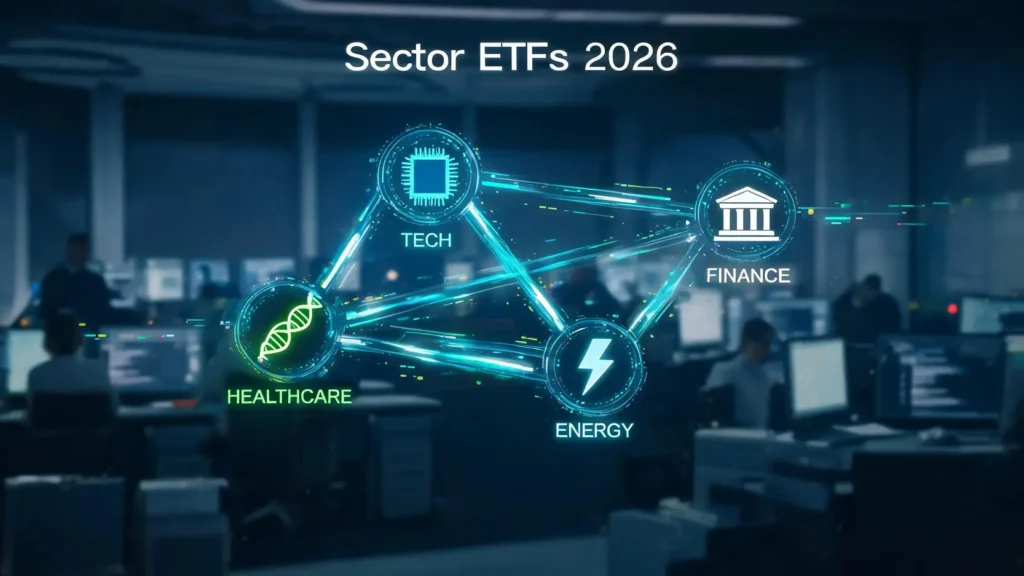
- Technology: Capturing innovation in software, hardware, and semiconductors.
- Healthcare: Focusing on pharmaceuticals, biotechnology, and medical device companies.
- Financials: Including banks, insurance companies, and FinTech innovators.
- Energy: Covering oil and gas corporations as well as renewable energy firms.
- Consumer Staples: Comprising companies that produce essential goods like food and household products.
The Big Debate: Pros and Cons of Sector ETF Investing
Investing in branchen etfs can be a powerful strategy, but it carries a unique risk-reward profile compared to diversified global ETFs. It’s a double-edged sword that requires careful consideration.
Advantages: The Potential for Higher Growth and Targeted Exposure
The primary allure of sector ETFs is the potential for alpha generation. If you have a strong, research-backed conviction that a particular industry (e.g., artificial intelligence or biotechnology) is poised for significant outperformance, a sector ETF allows you to make a targeted bet. This tactical tilting can enhance portfolio returns beyond what a broad-market index can offer.
Disadvantages: Increased Risk and Lack of Diversification
The flip side of concentration is elevated risk. By forgoing broad diversification, your investment becomes highly sensitive to headwinds affecting that one industry, such as regulatory changes, technological disruption, or shifts in consumer demand. A downturn in that single sector can lead to significant losses, unlike in a globally diversified portfolio where weakness in one area may be offset by strength in another.
When to Choose a Sector ETF Over a Global ETF
A sector ETF is appropriate when it serves a specific tactical purpose within a well-diversified portfolio. It should be used to express a high-conviction view on an industry cycle or a long-term structural growth story. In contrast, a global ETF like an MSCI World tracker should form the stable, long-term ‘core’ of most investment portfolios, especially for those with a lower risk tolerance or a preference for passive, set-and-forget investing.
An Overview of the Most Popular Sector ETFs in 2026
As we navigate 2026, several sectors are positioned at the forefront of economic trends. Below is a comparative analysis of prominent sectors and representative ETFs. The choice of the best sector ETFs in 2026 depends heavily on your individual risk tolerance and market outlook.
| Sector | Example ETF (Ticker) | 2026 Outlook & Focus | Key Risk Factor |
|---|---|---|---|
| Technology & AI | Invesco QQQ Trust (QQQ) | Continued growth driven by AI adoption, cloud computing, and digital transformation. High potential for innovation-led returns. | Increased regulatory scrutiny and high valuations. |
| Healthcare & Biotech | Health Care Select Sector SPDR Fund (XLV) | Demographic tailwinds from an aging global population and breakthroughs in biotechnology (e.g., gene editing). | Patent cliffs and political pressure on drug pricing. |
| Energy & Renewables | Energy Select Sector SPDR Fund (XLE) | Balancing traditional energy demand with the long-term structural shift towards renewables and grid modernization. | Commodity price volatility and geopolitical instability. |
| Financials & FinTech | Financial Select Sector SPDR Fund (XLF) | Beneficiaries of a stable interest rate environment; ongoing disruption from digital payments and blockchain technology. | Sensitivity to economic cycles and credit market health. |
How to Strategically Integrate Sector ETFs into Your Portfolio
Simply buying a trending sector ETF is not a strategy. Professional investors use a structured approach to incorporate these tools, often filling a gap that competitors’ advice overlooks.
The Core-Satellite Strategy: Using Sector ETFs as Tactical Plays
The most effective method for most investors is the Core-Satellite strategy. Here’s how it works:
- The Core: This forms the majority of your portfolio (typically 70-90%) and consists of low-cost, broadly diversified investments like an MSCI World or FTSE All-World ETF. This provides stability and captures global market returns.
- The Satellites: This smaller portion of your portfolio (10-30%) is used for tactical investments, including sector ETFs. These ‘satellites’ are used to overweight industries where you forecast above-average growth, thereby enhancing your potential returns without destabilizing the entire portfolio.
Determining Your Allocation: How Much Should You Invest?
There is no single answer, but a disciplined approach is crucial. A common guideline is to limit any single satellite (one sector ETF) to no more than 5% of your total portfolio value. The total allocation to all satellite positions should align with your risk tolerance. An aggressive investor might allocate up to 30% to satellites, while a conservative one might stick to 10%.
A Framework for Analyzing and Selecting the Right Sector ETF
Before investing, conduct thorough due diligence. Use this checklist:
- Index Methodology: What index does the ETF track? Is it market-cap-weighted or equal-weighted? Understand which companies are included and why.
- Expense Ratio (TER): Compare the Total Expense Ratio with other ETFs in the same sector. Lower is generally better.
- Liquidity and Fund Size (AUM): Larger ETFs with high trading volumes are generally easier and cheaper to buy and sell. Low liquidity can lead to higher bid-ask spreads.
- Tracking Difference: How closely has the ETF’s performance matched its benchmark index? A large and persistent negative tracking difference is a red flag.
Managing the Risks of Sector Investing: A Deeper Dive
Successful sector investing is defined by disciplined risk management. Here are key concepts to master.
Understanding Cyclical vs. Defensive Sectors
Sectors behave differently throughout an economic cycle:
- Cyclical Sectors: These (e.g., Consumer Discretionary, Technology, Industrials) perform well during economic expansions but are highly sensitive to recessions.
- Defensive Sectors: These (e.g., Consumer Staples, Healthcare, Utilities) provide goods and services that are in demand regardless of the economic climate, making them more stable during downturns.
Balancing exposure to both types can help smooth portfolio returns over time.
The Danger of Over-Concentration and How to Avoid It
The biggest pitfall is falling in love with a story and allocating too much capital to a single sector. To avoid this, set strict allocation limits (as discussed in the Core-Satellite strategy) and rebalance your portfolio periodically. If your technology satellite grows to become 20% of your portfolio, trim it back to your target allocation to lock in gains and manage risk.
Key Metrics to Watch: TER, Tracking Difference, and Fund Size
These metrics are vital for ETF selection:
- TER (Total Expense Ratio): The annual fee charged by the fund manager.
- Tracking Difference: The real-world gap between the ETF’s return and the index’s return. It includes the TER plus other costs like transaction fees and is a more accurate measure of cost.
- Fund Size (AUM): Assets Under Management. A very small fund (e.g., under $50 million) may face a higher risk of closure.
Conclusion: A Powerful Tool for the Disciplined Investor
Sector ETFs offer a powerful way to enhance portfolio returns and target high-growth industries, but they are a double-edged sword. Unlike diversified global ETFs, they demand more research, a clear investment thesis, and a disciplined understanding of the risks involved. By employing a Core-Satellite strategy, setting strict allocation limits, and carefully analyzing your choices based on key metrics, you can harness the potential of branchen etfs to your advantage. Always conduct thorough research and consider your own financial situation before making any investment decision.
Frequently Asked Questions
Are sector ETFs suitable for beginners?
For absolute beginners, it is generally advisable to start with a globally diversified, broad-market ETF to build a solid foundation. Sector ETFs are better suited for intermediate or advanced investors who have a well-established core portfolio and are comfortable conducting the necessary research to make targeted bets.
How many sector ETFs should I have in my portfolio?
There is no magic number, but less is often more. Holding too many sector ETFs begins to mimic the broad market but with higher fees and complexity. A common approach is to have 1-4 satellite positions to express your highest-conviction ideas without over-diversifying your tactical allocation.
Which sector has the best performance historically?
Sector performance is cyclical, and leadership rotates over time. While the Technology sector has delivered outstanding returns over the past decade, history shows that past performance is not indicative of future results. For instance, the Energy sector was a top performer in 2022 after years of underperformance. A sound strategy relies on forward-looking analysis rather than chasing past winners.