The recent gold rate decrease has many investors asking questions. If you’re wondering why gold prices are falling and what it means for your investment strategy, you’re in the right place. This article breaks down the primary drivers behind the current trend, analyzing the impact of a strong dollar and key economic data. We offer expert insights on what to do next, helping you understand the factors behind the current gold rate decrease.
Table of Contents
The Current Situation: A Snapshot of the Gold Market in 2026
Analyzing the Recent Price Action and Market Sentiment
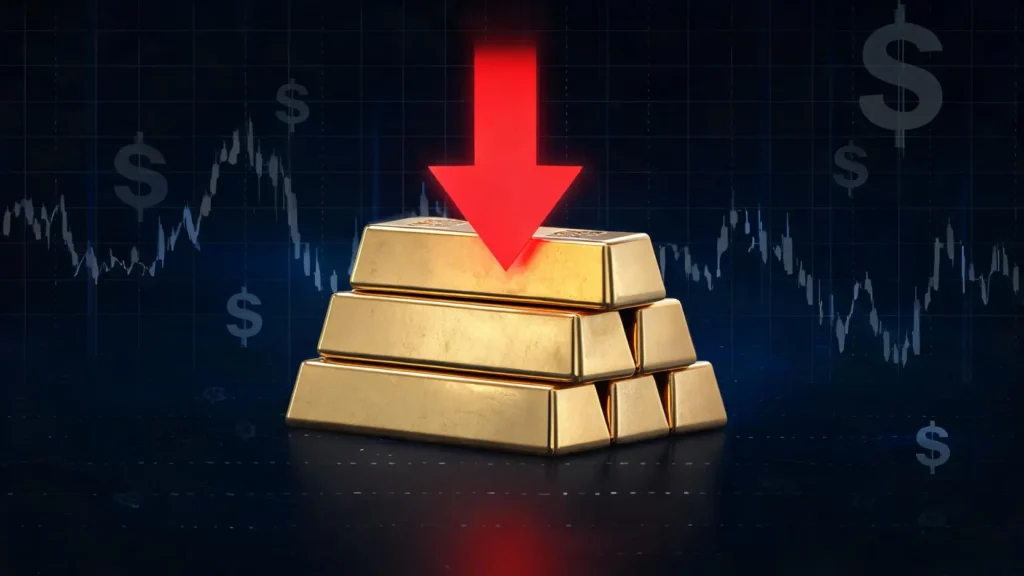
In the second quarter of 2026, gold prices have experienced a significant downturn, breaking below key support levels. After reaching a high near $2,400 per ounce earlier in the year, the precious metal has retraced, with market sentiment turning cautious. This gold rate decrease reflects a broader shift in investor confidence away from safe-haven assets towards riskier, higher-yield investments. The prevailing sentiment is driven by robust economic indicators and a less volatile geopolitical landscape, reducing the immediate appeal of gold as a hedge.
Key Economic Data Points Influencing Today’s Gold Prices
The latest economic reports are central to the current gold price drop. According to data from the U.S. Bureau of Labor Statistics, the economy added 115,000 jobs in April 2026, a sign of a resilient labor market. This stronger-than-expected data diminishes the likelihood of imminent interest rate cuts, putting downward pressure on non-yielding assets like gold. Investors are closely monitoring these figures as they directly inform the Federal Reserve’s policy decisions.
Top 5 Factors Causing the Gold Rate Decrease
1. The Strong US Dollar and Its Inverse Effect on Gold
A primary driver of the gold rate decrease is the strength of the US dollar. The U.S. Dollar Index (DXY) has climbed to a multi-year high in 2026, making gold more expensive for investors holding other currencies. This inverse relationship is a fundamental principle in commodity markets; as the dollar strengthens, demand for gold typically wanes, leading to lower prices.
2. Federal Reserve’s Stance on Interest Rates
The Federal Reserve’s hawkish stance on monetary policy is another significant factor. With inflation remaining persistent, the Fed has signaled its intention to keep interest rates higher for longer. High interest rates increase the opportunity cost of holding gold, which offers no yield. As a result, investors are moving capital into fixed-income assets that provide attractive returns, further contributing to the decline in gold prices.
3. Robust US Labor Market and Economic Data
As mentioned, the strong performance of the US labor market is a key bearish catalyst for gold. The consistent addition of non-farm payrolls, as reported by the U.S. Bureau of Labor Statistics, points to a healthy economy. This reduces the demand for gold as a safe-haven asset, as investors feel more confident deploying capital in growth-oriented sectors.
4. Shifting Investor Appetite from Safe Havens to Riskier Assets
With economic growth steady and corporate earnings on the rise, there has been a noticeable rotation out of defensive assets. Investors are showing a greater appetite for risk, favoring equities and other growth-focused instruments over traditional safe havens like gold. This shift in capital allocation is a major reason behind the current gold rate decrease.
5. Easing Geopolitical Tensions and Reduced Demand
A relative calm in the global geopolitical arena has also dampened the demand for gold. In early 2026, several international disputes have seen de-escalation, reducing the perceived need for a safe-haven asset to hedge against global instability. When geopolitical risks subside, gold’s appeal as a crisis hedge diminishes, leading to price corrections.
Future Outlook: Gold Price Forecasts for the Coming Months
Short-Term Technical Analysis: What the Charts Are Saying
From a technical standpoint, gold is currently in a bearish trend. The price is trading below its 50-day and 200-day moving averages, which are widely watched indicators of short-term and long-term momentum. The Relative Strength Index (RSI) is approaching oversold territory, which could signal a potential for a short-term bounce. However, key resistance is now expected at the $2,200 level, a previous support zone. A failure to reclaim this level would confirm the continuation of the downtrend.
Long-Term Fundamental Analysis: Predictions from J.P. Morgan and Other Experts
Major financial institutions have revised their long-term forecasts in light of the current market dynamics. While opinions vary, the consensus points towards a challenging environment for gold in the short to medium term. Here is a summary of recent forecasts for year-end 2026:
| Institution | Year-End 2026 Forecast | Key Rationale |
|---|---|---|
| J.P. Morgan | $2,150/oz | Persistent high interest rates and a strong dollar. |
| Goldman Sachs | $2,300/oz | Belief that central bank buying will provide a floor. |
| Citigroup | $2,200/oz | Economic resilience delaying Fed’s pivot to rate cuts. |
These predictions highlight the complex interplay of factors that will shape the gold market for the remainder of the year.
Potential Events That Could Reverse the Trend
Several catalysts could reverse the current gold rate decrease. A sudden flare-up in geopolitical tensions, a weaker-than-expected jobs report leading to a stock market correction, or a surprisingly dovish shift in the Federal Reserve’s language could all reignite demand for gold as a safe-haven asset. Investors should remain vigilant for these potential market-moving events.
Investor’s Playbook: How to Navigate a Gold Rate Decrease
Is a Price Dip a Buying Opportunity for Long-Term Investors?
For long-term investors who believe in gold’s role as a store of value and a hedge against systemic risk, a price dip can be viewed as a buying opportunity. Employing a dollar-cost averaging strategy—investing a fixed amount regularly—can help mitigate the risk of timing the market. A lower gold rate allows for the accumulation of more ounces for the same capital outlay, which can be advantageous over a multi-year horizon.
Strategies for Traders During Volatile Periods
Traders with a shorter time horizon might consider different strategies. Bearish traders could explore short-selling or buying put options to profit from further price declines. Conversely, those anticipating a reversal could wait for bullish confirmation signals, such as a break above a key resistance level, before entering a long position. In either case, disciplined risk management is paramount.
The Role of Gold in a Diversified Portfolio Today
Despite the current downturn, gold remains a critical component of a well-diversified investment portfolio. Its low correlation with other asset classes, like equities and bonds, means it can provide stability during periods of market stress. The current gold rate decrease does not negate its long-term function as a hedge against inflation and currency debasement.
Conclusion
In conclusion, the current gold rate decrease is a multifaceted event driven primarily by a strong US dollar, hawkish Federal Reserve policies, and positive economic data. While this creates short-term uncertainty, investors should assess their strategy based on their long-term goals. Understanding these core factors is key to navigating the market and making informed decisions whether you plan to buy, sell, or hold. The differentiation points for savvy investors will be analyzing expert long-term forecasts and preparing an investment playbook that aligns with their personal risk tolerance.
FAQ
Why did the gold rate decrease so sharply?
The sharp decrease is due to a combination of factors: a strong U.S. dollar, expectations of continued high interest rates from the Federal Reserve, robust U.S. economic data, and a general shift in investor sentiment from safe havens to riskier assets.
Is gold still a good hedge against inflation when its price is falling?
Yes, over the long term, gold has historically served as a reliable hedge against inflation. Short-term price movements are often influenced by other factors like interest rates and currency strength. Its value lies in its ability to preserve purchasing power over decades, not necessarily month-to-month.
How do US interest rates affect the price of gold?
Higher interest rates increase the opportunity cost of holding gold, which pays no interest or dividends. This makes interest-bearing assets like bonds more attractive, leading investors to sell gold and buy bonds, thus pushing the gold price down.
What is the gold price prediction for the next 5 years?
Predictions vary, but most long-term outlooks remain positive, contingent on future economic cycles. Many analysts believe that eventual monetary easing, coupled with persistent global debt levels and central bank buying, will support higher gold prices over a 5-year horizon, though volatility is expected.