In the relentless search for investment alpha, modern investors require tools that offer flexibility, diversification, and cost-efficiency. Exchange-Traded Funds (ETFs) have emerged as a primary solution, blending the accessible nature of stocks with the diversified portfolio of mutual funds. This guide demystifies exchange etfs, providing a strategic blueprint for not only understanding what they are but how to leverage their unique structure for superior investment outcomes. We will explore a comprehensive ETF investing guide and highlight the path to low-cost diversification.
Table of Contents
What is an Exchange-Traded Fund (ETF)? A 2026 Perspective
At its core, an Exchange-Traded Fund is a basket of securities—such as stocks, bonds, or commodities—that you can buy and sell on a stock exchange, just like an individual stock. Think of it as owning a small, diversified portfolio with a single transaction. This structure provides a crucial advantage over traditional investment funds.
The Core Components: ‘Exchange-Traded’ + ‘Fund’
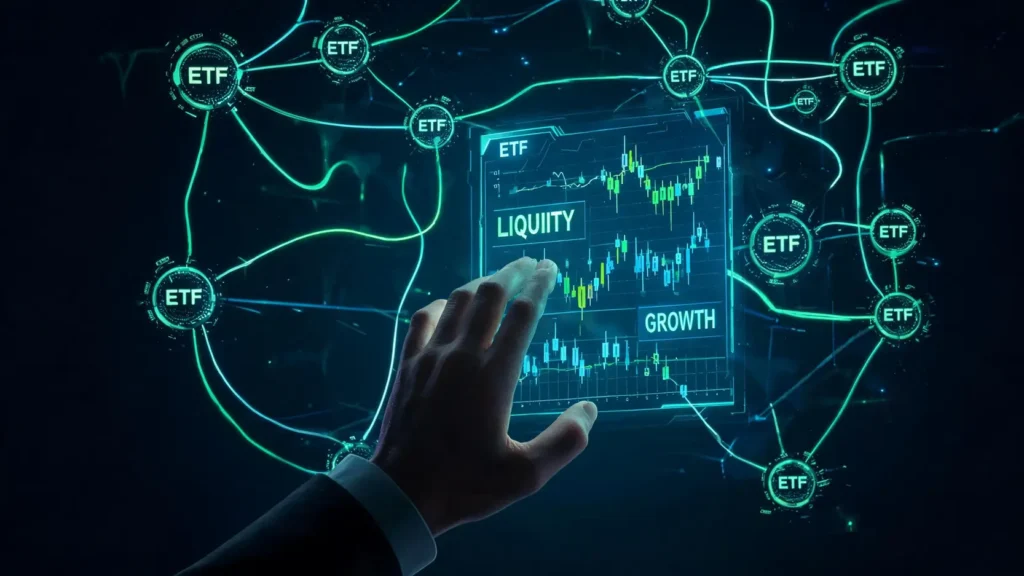
The name itself tells you everything. The ‘Fund’ aspect signifies that it holds a collection of assets, offering instant diversification. The ‘Exchange-Traded’ part is the game-changer: it means the fund’s shares are created, redeemed, and traded on major exchanges like the NYSE or NASDAQ throughout the day, providing liquidity and price transparency that older fund structures lack.
Table: ETF vs. Mutual Fund vs. Stock in 2026
To truly grasp the unique position of ETFs, a direct comparison is essential. This table breaks down the key operational and cost differences every investor must understand.
| Feature | Exchange-Traded Fund (ETF) | Mutual Fund | Individual Stock |
|---|---|---|---|
| Trading | Intraday on a stock exchange | Once per day at Net Asset Value (NAV) | Intraday on a stock exchange |
| Management | Typically passive (tracks an index) | Often actively managed | No management (self-directed) |
| Expense Ratio | Generally low (e.g., 0.03% – 0.75%) | Generally higher (e.g., 0.5% – 2.0%+) | N/A (trading commissions apply) |
| Price Transparency | Real-time pricing | Priced once at market close | Real-time pricing |
| Tax Efficiency | High, due to in-kind creation/redemption process | Lower, can generate large capital gains distributions | High, gains realized only upon selling |
The Trader’s Edge: Why ‘Exchange-Traded’ is Your Biggest Advantage
While diversification is a known benefit, the strategic edge of an exchange-traded fund lies in its trading mechanics. This is where sophisticated investors find opportunities that are absent in other investment tools.
Mastering Intraday Trading: Moving at the Speed of the Market
Economic data release? Geopolitical event? An ETF allows you to react in real-time. Unlike a mutual fund where your buy or sell order is executed at an unknown price hours later, an ETF can be traded instantly. This allows for tactical asset allocation, hedging, or capitalizing on market volatility. A London-based trader wouldn’t wait until the end of the day to adjust a position; they act on the information as it hits the market. ETFs bring that capability to all investors.
Decoding Price Transparency: The Truth About Bid-Ask Spreads & Slippage
Real-time pricing is a double-edged sword. Every exchange-traded security has a ‘bid’ price (what buyers will pay) and an ‘ask’ price (what sellers will accept). This gap is the bid-ask spread. For highly liquid ETFs like those tracking the S&P 500, this spread is negligible. However, for less-traded, thematic ETFs, the spread can be a significant hidden cost. ‘Slippage’ occurs when your market order is filled at a worse price than anticipated due to a wide spread or low volume. As the U.S. Securities and Exchange Commission (SEC) advises, using limit orders is a key risk management technique in such scenarios.
Building Your 2026 Portfolio: A Survey of the ETF Universe
The ETF market has grown exponentially, now offering exposure to nearly every conceivable asset class, region, or investment strategy. The global ETF market size is projected by industry reports from BlackRock and State Street to exceed $15 trillion by the end of 2026, underscoring their importance.
Core Holdings: Index and Bond ETFs
These are the foundational blocks of a portfolio. Stock ETFs that track broad indices like the S&P 500 (e.g., SPY, IVV) or the Nasdaq 100 (e.g., QQQ) provide market-level equity exposure. Bond ETFs (e.g., BND, AGG) offer diversification and income through a basket of fixed-income securities.
Satellite & Thematic Plays: Sector, Commodity, and Innovation ETFs
For more targeted exposure, investors can use Sector ETFs (e.g., XLK for technology), Commodity ETFs (e.g., GLD for gold), or actively managed Thematic ETFs (e.g., ARKK for disruptive innovation). These carry higher risk and volatility but offer potential for outsized returns.
[Data Table] 2026 ETF Snapshot: Key Metrics for Leading Funds
Research is paramount. This table presents hypothetical up-to-date metrics for popular ETFs as of Q2 2026 to illustrate what to look for. (Note: Data is illustrative for educational purposes and does not represent actual performance).
| Ticker | Name | Expense Ratio | AUM (Billions) | Avg. Bid-Ask Spread |
|---|---|---|---|---|
| SPY | SPDR S&P 500 ETF Trust | 0.09% | $450 | 0.01% |
| BND | Vanguard Total Bond Market ETF | 0.03% | $310 | 0.02% |
| GLD | SPDR Gold Shares | 0.40% | $60 | 0.02% |
| ARKK | ARK Innovation ETF | 0.75% | $12 | 0.08% |
A Balanced View: Weighing the Benefits and Real-World Risks
No investment tool is without drawbacks. A sophisticated investor weighs the pros against the often-overlooked cons before committing capital. An ETF investing strategy must be risk-aware.
The Obvious Pros: Diversification, Low ERs, and Tax Efficiency
These benefits are well-documented. Gaining exposure to hundreds of securities with one purchase, paying minimal management fees (Expense Ratios), and deferring capital gains taxes until sale are the primary reasons for the ETF boom.
The Hidden Cons: Tracking Error, Counterparty Risk, and Liquidity Gaps
Beyond bid-ask spreads, investors must consider:
- Tracking Error: This is the discrepancy between the ETF’s performance and the performance of its underlying index. While often small, it can impact returns.
- Counterparty Risk: Primarily in synthetic ETFs (more common in Europe), this is the risk that the institution backing the ETF’s derivative contracts could default.
- Liquidity Gaps: During a market flash crash, the liquidity for even large ETFs can temporarily dry up, leading to extreme bid-ask spreads and difficulty in exiting a position at a fair price.
Your First Trade: A 3-Step Tactical Guide to Investing in ETFs
Moving from theory to practice requires a clear, actionable plan. Here is how to start investing in exchange ETFs with a focus on mitigating risk and cost.
Step 1: Choosing a Brokerage (Hint: Look at Commission-Free ETFs)
Most major online brokerages now offer commission-free trading on a wide selection of ETFs. Compare platforms not just on fees, but on the quality of their research tools and the breadth of their commission-free ETF list.
Step 2: Vetting Your ETF: Beyond the Expense Ratio
A low expense ratio is attractive, but it’s not the only factor. A proper vetting process involves checking:
- Assets Under Management (AUM): Higher AUM (e.g., over $100 million) generally indicates better liquidity and stability.
- Trading Volume: High average daily volume ensures a tight bid-ask spread.
- Tracking Error: Review the fund’s historical data to see how closely it has tracked its benchmark index.
Step 3: Executing the Trade: Why a Limit Order Protects You
When you are ready to buy, avoid using a ‘market order.’ A market order buys at the next available price, which could be unfavorable (slippage). Instead, use a limit order. A limit order allows you to specify the maximum price you are willing to pay. For example, if an ETF is trading with a bid of $49.98 and an ask of $50.02, setting a limit order to buy at $50.00 ensures you don’t overpay if the price suddenly spikes.
Conclusion: The Strategic Imperative of Understanding ETFs
Exchange-Traded Funds offer a powerful combination of diversification, a low-cost structure, and the trading flexibility of stocks precisely because they are listed on an exchange. For the modern investor, understanding the mechanics of exchange etfs—from intraday liquidity to the nuances of the bid-ask spread—is no longer optional; it is a crucial step toward building a resilient and agile investment portfolio. The next step is to begin vetting your first ETF, aligning it with your long-term financial goals while using the tactical risk controls outlined in this guide.
Frequently Asked Questions (FAQ)
-
What is the main difference between an ETF and a mutual fund?
- The primary difference is how they are traded. ETFs trade like stocks on an exchange throughout the day at changing prices. Mutual funds are priced once per day after the market closes, and all transactions occur at that single price (NAV).
-
Can you lose all your money in an ETF?
- Yes. An ETF’s value is tied to its underlying assets. If you invest in an S&P 500 ETF and the S&P 500 market crashes, the value of your ETF will fall accordingly. Leveraged or inverse ETFs carry even higher risks, where losses can be magnified. Investing always involves risk, as stated by financial authorities like the FCA and SEC.
-
How do ETF providers make money?
- ETF providers, such as Vanguard or BlackRock, primarily earn revenue from the expense ratio. This is an annual fee charged as a percentage of the fund’s total assets. While small on an individual basis, on a fund with billions in AUM, it generates substantial revenue.