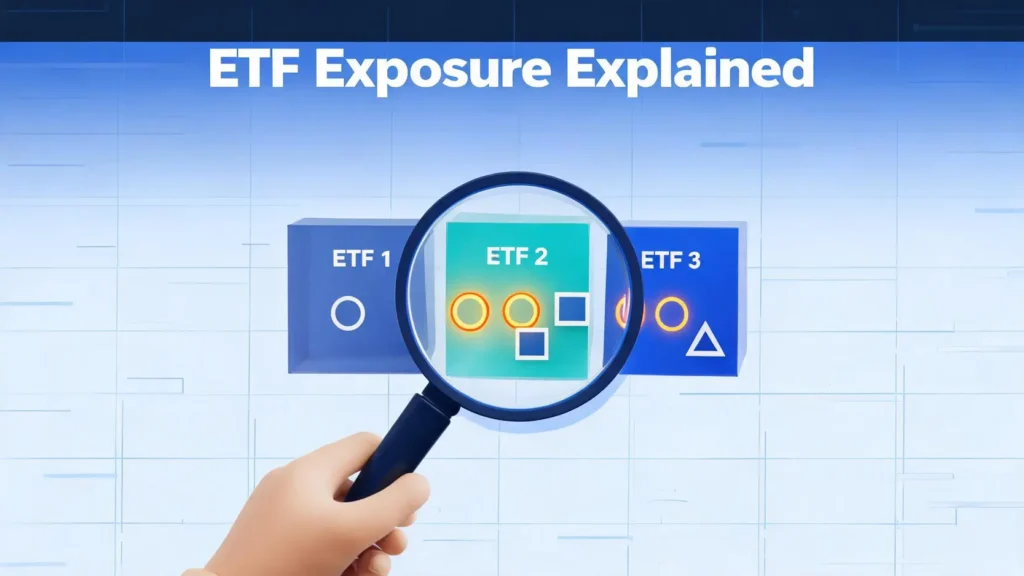
Investing in an Exchange-Traded Fund (ETF) is easy, but do you truly know what you’re buying into? Understanding ETF exposure is the key to unlocking true diversification and protecting your portfolio from unexpected risks. This concept, which defines the specific underlying assets you own through the fund, is critical for any serious investor looking to gain diversified exposure through ETFs. This guide breaks down everything you need to know about what’s inside your ETF, transforming you from a passive investor into a strategic one.
Table of Contents
What is ETF Exposure?
ETF exposure refers to the collection of underlying assets—stocks, bonds, commodities, or other securities—that an ETF holds to track its target index. Grasping this concept is fundamental to understanding exactly what you own and the market segments your investment is tied to.
A Simple Definition: The Underlying Assets You Own
In the simplest terms, ETF exposure is the answer to the question: “What am I actually invested in?” When you buy a share of an ETF, you are not buying a single stock but a share of a portfolio that contains numerous individual securities. The collective performance of these assets determines the ETF’s value. For example, an S&P 500 ETF gives you exposure to 500 of the largest U.S. publicly traded companies.
The ‘Basket’ Analogy: How ETFs Provide Instant Diversification
Think of an ETF as a pre-packaged basket of investments. Instead of going to the market and hand-picking hundreds of different fruits (stocks), you can buy a single “fruit basket” ETF. This basket provides immediate diversification across various securities. As explained by major issuers like BlackRock, this structure is a primary advantage of ETFs, allowing investors to spread risk more effectively than by purchasing a small number of individual stocks. This diversification helps mitigate the impact of poor performance from any single asset within the basket.
Why Exposure Matters: Key Benefits for Your Portfolio
Understanding and strategically using ETF exposure can significantly enhance your investment strategy. It’s not just about owning many assets; it’s about owning the right combination of assets to meet your financial goals.
Achieving Broad Market Access with a Single Trade
ETFs offer an incredibly efficient way to gain exposure to entire markets. With one transaction on a stock exchange, you can invest in the U.S. stock market (e.g., via an S&P 500 ETF), international equities, or even niche sectors like renewable energy or cybersecurity. This accessibility simplifies the investment process and lowers the barrier to entry for building a globally diversified portfolio.
Cost-Effective Diversification vs. Buying Individual Stocks
Attempting to replicate the portfolio of an index like the Nasdaq-100 by buying each of the 100 individual stocks would be prohibitively expensive for most investors due to transaction fees and the high cost of certain shares. ETFs solve this problem by offering a share in the complete portfolio at a fraction of the cost, with expense ratios often being significantly lower than traditional mutual funds.
Targeting Specific Investment Themes and Strategies
Beyond broad markets, ETFs allow you to target specific investment themes, or “megatrends.” Whether you believe in the future of artificial intelligence, genomics, or emerging market consumer growth, there is likely an ETF that provides concentrated exposure to companies in that space. This allows for precise, strategic tilts in your portfolio to capitalize on specific growth opportunities.
The Main Types of ETF Exposure
ETF exposure can be categorized in several ways, each offering a different lens through which to build and analyze a portfolio. Understanding these categories is essential for constructing a well-rounded investment strategy that aligns with your risk tolerance and objectives.
| Exposure Type | Description | Examples |
|---|---|---|
| Asset Class | The fundamental category of financial instruments. This is the broadest level of diversification. | Stocks (Equities), Bonds (Fixed Income), Commodities (Gold, Oil), Real Estate. |
| Geographical | Exposure to the economies and markets of specific countries or regions. | U.S. (SPY), International Developed Markets (VEA), Emerging Markets (VWO), single-country (EWJ for Japan). |
| Sector & Industry | Focuses on specific segments of the economy, allowing for targeted bets on industry trends. | Technology (XLK), Healthcare (XLV), Financials (XLF), Energy (XLE). |
| Factor | Targets specific drivers of return identified by academic research, such as Value or Growth. | Value (VTV), Growth (VUG), Momentum (MTUM), Quality (QUAL), Low Volatility (USMV). |
Factor Exposure (Value, Growth, Momentum)
Factor investing is a more sophisticated strategy that involves targeting specific characteristics, or “factors,” that have historically been associated with higher returns. As defined by research firms like Morningstar, these factors are persistent, data-driven drivers of performance. For example, a ‘Value’ ETF focuses on stocks that appear underpriced relative to their fundamentals, while a ‘Momentum’ ETF invests in stocks that have shown strong upward price trends.
How to Check an ETF’s Exposure: A Step-by-Step Guide
Analyzing an ETF’s holdings is a critical due diligence step. Fortunately, this information is readily available and transparent. Here’s a practical walkthrough using three common methods.
Method 1: Using the ETF Issuer’s Official Website
The most reliable source of information is always the fund issuer itself. Issuers like Invesco, iShares (by BlackRock), and Vanguard provide daily updates on their fund’s holdings.
- Navigate to the official website of the ETF provider (e.g., Invesco for the QQQ ETF).
- Search for the specific ETF ticker symbol (e.g., “QQQ”).
- Look for a tab or section labeled “Holdings,” “Portfolio,” or “Portfolio Composition.”
- Here, you will find a detailed list of the underlying securities, their weights in the portfolio, and sector breakdowns. For instance, the official Invesco QQQ page clearly lists its top holdings and their percentage allocation.
Method 2: Leveraging Free Financial Portals
Major financial news and data websites are excellent resources for quick analysis.
- Go to a reputable portal like Yahoo Finance, Bloomberg, or Morningstar.
- Enter the ETF ticker in the search bar.
- On the ETF’s main page, find the “Holdings” or “Portfolio” section.
- These sites provide a comprehensive overview, often including top 10 holdings, sector weightings, and key portfolio metrics.
Method 3: Using Specialized Tools like ETF.com or ETFdb.com
For deeper, comparative analysis, specialized ETF screening tools are invaluable. Websites like ETF.com and ETFdb.com offer powerful databases that allow you to not only see an ETF’s holdings but also compare it side-by-side with other funds, screen for ETFs with exposure to a specific stock, and analyze potential portfolio overlap.
Understanding the Risks Associated with ETF Exposure
While ETFs are powerful tools for diversification, they are not without risk. Understanding the nuances of their exposure is critical to avoiding common pitfalls. The U.S. Securities and Exchange Commission (SEC) provides investor bulletins that highlight several of these risks.
Concentration Risk: When Diversification Fails
Not all ETFs are broadly diversified. A market-cap-weighted index fund, like a Nasdaq-100 ETF, can have significant concentration risk. This means a large percentage of the fund’s assets are concentrated in a small number of mega-cap stocks. For example, the top 10 holdings might comprise over 50% of the ETF’s total value. A downturn in just one or two of these key companies can have a disproportionate impact on the ETF’s overall performance.
The Hidden Danger of ‘Exposure Overlap’ in Your Portfolio
A common mistake investors make is assuming that owning multiple ETFs automatically equals better diversification. This is often not the case due to exposure overlap. For instance, if you own both an S&P 500 ETF and a technology-focused ETF (like XLK), you are likely doubling down on your exposure to companies like Apple, Microsoft, and NVIDIA, as they are major components of both indexes. This can lead to unintentional over-concentration and higher portfolio risk than you realize. It is essential to analyze your total portfolio exposure to ensure your holdings are genuinely distinct and aligned with your desired allocation.
Counterparty Risk in Synthetic and Leveraged ETFs
While most common ETFs hold the underlying assets directly (physical replication), some specialized products like synthetic or leveraged ETFs use derivatives (swaps, futures) to achieve their exposure. This introduces counterparty risk—the risk that the other party in the derivatives contract (usually a large bank) fails to meet its obligations. The SEC specifically warns investors about the unique risks of these complex products, which are generally not intended for long-term, buy-and-hold investors.
Mastering ETF Exposure for Strategic Investing
Mastering ETF exposure is about moving from a passive investor to a strategic one. By understanding exactly what assets your ETFs hold, their concentrations, and how they overlap within your portfolio, you can build a more resilient, diversified, and effective investment strategy. Start by analyzing the exposure of your top holdings today to ensure your investments are truly aligned with your long-term financial goals.
FAQ
What is considered high exposure in an ETF?
High exposure typically refers to a situation where a single holding accounts for more than 5-10% of an ETF’s assets, or when the top 10 holdings make up more than 40-50% of the portfolio. This is a sign of high concentration risk, where the fund’s performance becomes heavily dependent on a few key stocks.
Can I get ETF exposure to cryptocurrency?
Yes. As of 2024, regulators in the U.S. and other regions have approved spot Bitcoin and Ethereum ETFs. These funds directly hold the cryptocurrency, providing investors with exposure to its price movements through a regulated, exchange-traded product without needing to manage a digital wallet.
How is ETF exposure different from mutual fund exposure?
The core concept of exposure is the same—both provide a share in a basket of underlying assets. The key differences are in transparency and trading. ETF holdings are typically disclosed daily, offering high transparency. Mutual fund holdings are often disclosed only quarterly. Furthermore, ETFs trade on an exchange throughout the day like stocks, while mutual funds are priced and traded only once per day after the market closes.