Confused about whether to invest in individual stocks or ETFs? You’re not alone. This guide breaks down everything you need to know about ‘etf aktier‘ (ETF stocks), explaining the key differences to help you decide which is the right choice for your investment goals. Understanding the difference between investing in ETFs versus individual stocks is the first step toward building a resilient portfolio for 2026 and beyond.
Table of Contents
First, What Is a Stock (Aktie)?
Before diving into ETFs, it’s crucial to understand the fundamental building block of the stock market: the stock itself. A stock represents a share of ownership in a single company.
Understanding Ownership in a Company
When you purchase a stock (in Swedish, ‘aktie’), you are buying a small piece of that corporation. This makes you a shareholder, giving you a claim on the company’s assets and a fraction of its profits. If the company performs well and its value increases, the price of your stock is likely to rise. Conversely, if the company struggles, your stock’s value may fall.
The Risk and Reward of Single Stocks
The primary appeal of single stocks is the potential for high returns. A well-chosen stock in a growing company can generate substantial profits. However, this potential comes with significant risk. By investing in only one company, your financial outcome is tied directly to its success or failure. This lack of diversification means that poor performance or unforeseen market challenges can lead to a substantial loss of your investment.
What Is an ETF? The ‘Basket of Stocks’ Explained
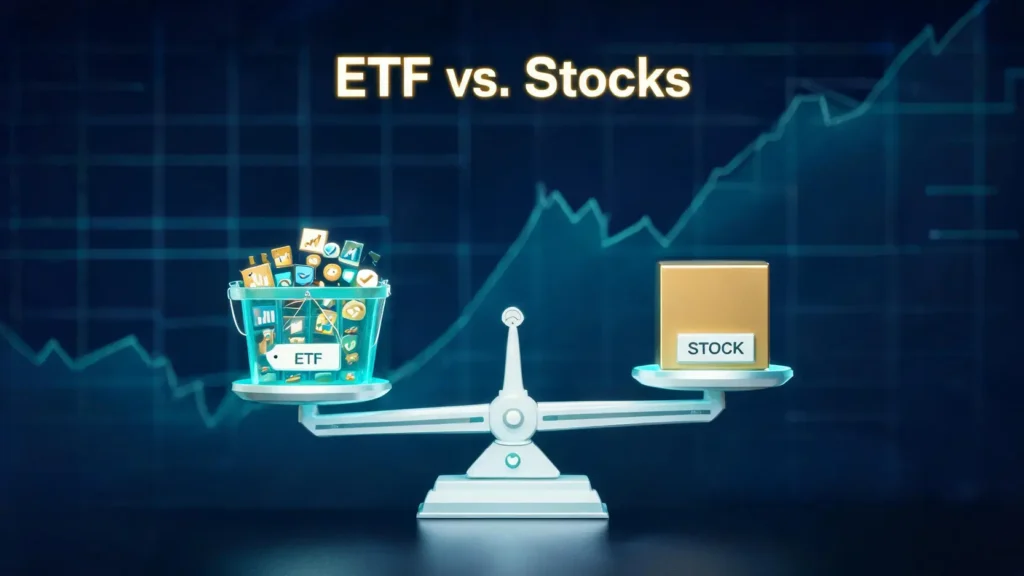
An Exchange-Traded Fund (ETF) is an investment vehicle that holds a collection of assets, such as stocks, bonds, or commodities. When you invest in an ETF of stocks, you are effectively buying a diversified portfolio in a single transaction.
How ETFs Work: Tracking an Index
Most ETFs are designed to track a specific market index, like the S&P 500 or the NASDAQ 100. For instance, an S&P 500 ETF holds shares in all 500 companies within that index. Its goal is not to beat the market but to mirror its performance. This passive management strategy is a key reason why ETFs often have lower fees.
Why They Are Traded Just Like Stocks
As the name suggests, Exchange-Traded Funds are bought and sold on stock exchanges throughout the day, just like individual stocks. Their prices fluctuate based on supply and demand, allowing investors to trade them with the same ease and flexibility as any other stock.
Key Differences: ETF vs. Individual Stock at a Glance
Understanding the core distinctions between etf aktier and single stocks is fundamental to making an informed investment decision. Here’s a breakdown of the most critical factors.
Diversification: One vs. Many
With a single stock, you own a piece of one company. With an ETF, you gain instant ownership in hundreds or even thousands of companies. This built-in diversification is the most significant advantage of ETFs, as it spreads your investment across various sectors and industries, reducing the impact of poor performance from any single company.
Cost: Management Fees vs. Brokerage Fees
Investing in individual stocks typically involves brokerage fees (commissions) for each transaction. While many brokers now offer zero-commission trades, other fees may apply. ETFs, on the other hand, come with an expense ratio—an annual management fee expressed as a percentage of your investment. For most passive index ETFs, these fees are extremely low, often below 0.10%.
Risk Management: Spreading Your Bets
Because ETFs hold a wide range of assets, they are inherently less volatile than individual stocks. The risk is spread out, so a sharp decline in one stock within the fund will have a minimal impact on the ETF’s overall value. This makes managing risk much simpler, especially for beginners.
The Main Advantages of Investing in ETFs
For those new to the market, the benefits of ETFs often make them a more suitable starting point than picking individual stocks. Here are the primary advantages.
Instant Diversification for Lower Risk
As mentioned, diversification is the cornerstone of sound investing. ETFs provide it automatically. Building a similarly diversified portfolio with individual stocks would require significant capital and extensive research, making ETFs a more efficient tool for achieving a balanced portfolio.
Lower Costs and Fees on Average
ETFs are known for their cost-efficiency. The average expense ratio for passive ETFs is significantly lower than that of actively managed mutual funds. This low-cost structure means more of your money stays invested and working for you, compounding over time.
Simplicity and Accessibility for Beginners
ETFs simplify the investment process. Instead of analyzing hundreds of individual companies, a beginner can start by investing in a broad-market ETF. This accessibility removes a major barrier to entry and allows new investors to participate in market growth without needing expert-level knowledge.
The Hidden Risks of ETFs You Must Know in 2026
While ETFs are generally safer than single stocks, they are not without risks. Being aware of these potential downsides is crucial for any investor.
Market Risk: You Can’t Eliminate It Completely
Diversification protects you from single-company failure, but not from broad market downturns. If the entire stock market declines, the value of your stock ETF will fall as well. This systemic risk, or market risk, is an inherent part of investing in equities.
Tracking Errors: When an ETF Doesn’t Match Its Index
A tracking error occurs when there is a difference between the performance of an ETF and the index it is meant to track. While usually small, factors like management fees, transaction costs, and cash drag can cause these discrepancies. It’s important to choose ETFs from reputable providers known for their minimal tracking errors.
Liquidity Issues in Niche ETFs
Broad-market ETFs are typically very liquid, meaning they can be bought and sold easily. However, niche or thematic ETFs that focus on very specific industries may have lower trading volumes. This can lead to a wider bid-ask spread, making it more expensive to enter and exit positions.
How to Start Investing in ETFs: A 4-Step Guide
Ready to begin your investment journey with ETFs? This simple, four-step guide will walk you through the process of how to start investing in ETFs.
Step 1: Choose the Right Online Broker
Your first step is to open an investment account with an online brokerage firm. Look for a platform with a user-friendly interface, a wide selection of commission-free ETFs, and strong educational resources. Compare fees and account minimums before making a decision.
Step 2: Research and Select Your First ETF
Once your account is set up, it’s time to choose an ETF. For beginners, a broad-market index ETF, such as one tracking the S&P 500 or a total world stock index, is an excellent starting point. Research its expense ratio, holdings, and historical performance.
Step 3: Place Your Buy Order
Placing an order for an ETF is similar to buying a stock. You will need to enter the ETF’s ticker symbol (e.g., VOO for the Vanguard S&P 500 ETF) and the number of shares you wish to purchase or the total amount you want to invest. You can choose between a market order (buys at the current price) or a limit order (buys only at a specific price or better).
Step 4: Monitor and Rebalance Your Portfolio
Investing is a long-term strategy. Regularly monitor your portfolio’s performance, but avoid making emotional decisions based on short-term market fluctuations. Periodically, you may need to rebalance your portfolio—selling some assets and buying others—to maintain your desired asset allocation.
Frequently Asked Questions about ETF Aktier
Which type of ETF is best for a beginner?
For most beginners, a broad-market index ETF is the ideal starting point. These ETFs, which track major indices like the S&P 500 or a total stock market index, offer maximum diversification and very low costs. They provide a solid foundation for any investment portfolio.
Can you lose all your money in an ETF?
While technically possible in a catastrophic market collapse, it is extremely unlikely to lose all your money in a diversified ETF. For a broad-market ETF to go to zero, hundreds of the world’s largest companies would have to fail simultaneously. The risk of total loss is significantly lower than with an individual stock.
How are gains from ETFs taxed compared to stocks?
In most jurisdictions, the tax treatment for ETFs and stocks is very similar. Capital gains taxes are typically owed when you sell your shares for a profit. The tax rate often depends on how long you held the investment (short-term vs. long-term). Additionally, dividends received from both ETFs and stocks are usually taxed as income.
Conclusion: Are ETFs a Smarter Choice Than Stocks?
For most beginners, investing in ‘etf aktier‘ is a smarter, safer, and more cost-effective way to enter the stock market. They offer the power of diversification in a single, easy-to-trade product. While individual stocks can offer higher rewards, they come with significantly higher risk and require more research. By starting with ETFs, you build a solid foundation for your investment future.