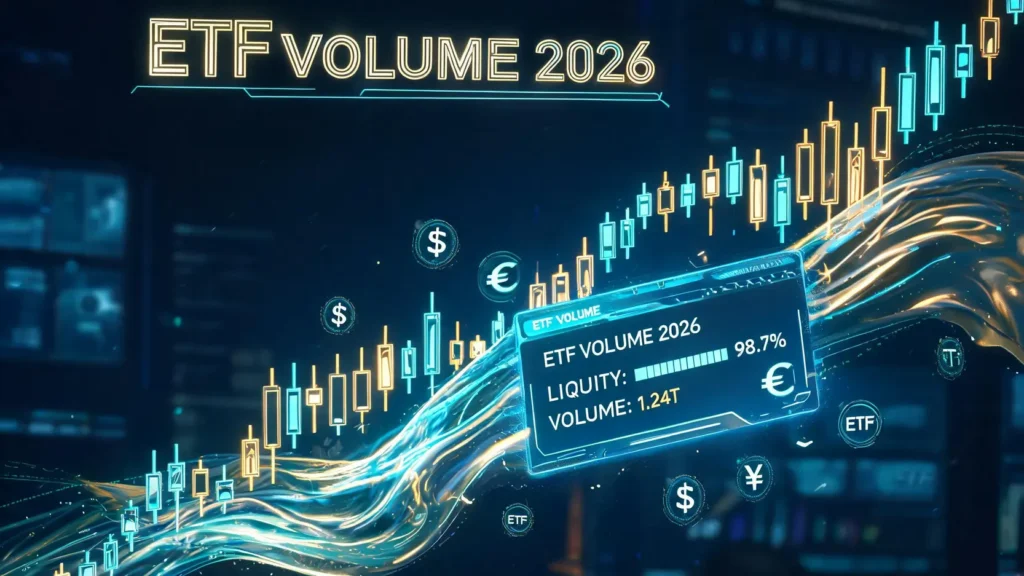
Many investors overlook a critical factor that can eat into their returns: execution costs driven by wide bid-ask spreads. Searching for the most active ETFs by volume is often the first step active traders take to ensure better liquidity, tighter spreads, and faster execution. However, trading volume isn’t the whole story. In 2026, as market dynamics evolve, understanding true ETF liquidity is more important than ever. This guide will reveal the most active ETFs on the market today and explain the hidden mechanics of ETF liquidity.
Table of Contents
What Does ETF Trading Volume Actually Mean?
When evaluating an ETF by volume, investors are primarily looking at how many shares change hands on a given trading day. But to fully grasp its impact on your investment strategy, we must break down the core components of ETF trading activity.
Defining Average Daily Volume (ADV) in the ETF Market
Average Daily Volume (ADV) measures the average number of shares traded per day over a specific period. For most active ETFs, a high ADV indicates substantial market interest and continuous trading activity. In 2026, benchmark funds consistently show ADVs in the tens of millions. High ETF trading volume generally signals that entering or exiting a position can be done swiftly without significantly impacting the market price.
The Direct Impact of Volume on Bid-Ask Spreads
The relationship between ETF trading volume and bid-ask spreads is a crucial element of market execution. The bid-ask spread represents the difference between the highest price a buyer is willing to pay and the lowest price a seller will accept. Highly liquid, most active ETFs typically feature extremely tight bid-ask spreads, often as low as a single penny. Conversely, lower volume funds might exhibit wider spreads, which act as a hidden transaction cost. Therefore, tracking ETF liquidity through volume helps investors minimize these execution costs.
Top Most Active ETFs by Trading Volume in 2026
The landscape of the most active ETFs by volume features a mix of traditional market index trackers and newly prominent sector-specific funds.
Broad Market Giants (e.g., SPY, QQQ, IWM)
Broad market index funds consistently dominate the charts. For instance, the SPDR S&P 500 ETF Trust (SPY) and Invesco QQQ Trust (QQQ) regularly record massive daily trading volumes, ensuring maximum ETF liquidity. Additionally, the iShares Russell 2000 ETF (IWM) remains a top vehicle for small-cap exposure, often seeing trading volumes exceeding 40 million shares daily. These giants offer tighter spreads and are the go-to instruments for institutional and retail traders alike.
Sector, Thematic, and Leveraged Heavyweights
Beyond the broad indices, specific thematic and leveraged funds frequently appear among the top most active ETFs. In 2026, cryptocurrency-related funds like the iShares Bitcoin Trust (IBIT) have sustained massive trading volumes, frequently trading over 15 million shares daily. On the leveraged side, funds like the Direxion Daily Small Cap Bear 3X Shares (TZA) often lead the volume pack during periods of market volatility. These funds cater to active traders looking for magnified exposure or specialized asset classes.
The ETF Liquidity Myth: Hidden Liquidity Beyond the Screen
A common misconception among traders is that an ETF’s on-screen volume dictates its absolute liquidity. In reality, the ETF structure possesses unique mechanisms that provide additional layers of liquidity.
Why Low Screen Volume Doesn’t Always Mean Low Liquidity
Searching for an ETF by volume might lead you to dismiss a newer or niche fund with low ADV. However, an ETF is only as liquid as its underlying basket of securities. If the individual stocks or bonds held by the fund are highly liquid, the ETF itself remains liquid, regardless of its own daily trading volume. This means traders can often execute large block trades in ostensibly low-volume ETFs without experiencing significant price slippage.
The Role of Authorized Participants (APs) and the Creation/Redemption Process
The secret to this hidden ETF liquidity lies in the creation/redemption process managed by Authorized Participants (APs). APs are large financial institutions that have the right to create new shares of an ETF or redeem existing ones. If demand for an ETF surges, pushing its price above the Net Asset Value (NAV), APs will buy the underlying assets, deliver them to the ETF issuer, and create new ETF shares to meet the demand. This dynamic process ensures that ETF trading volume does not artificially inflate or deflate the fund’s price relative to its intrinsic value, maintaining market equilibrium.
How to Assess the True Liquidity of the Underlying Assets
To accurately evaluate an ETF’s true liquidity, investors must look past the surface ETF trading volume. Examine the liquidity of the underlying assets. Are the holdings large-cap multinational equities, or are they illiquid emerging market debts? Analyzing the underlying bid-ask spreads and the ADV of the individual components provides a far more accurate picture of how easily the ETF can be traded during market stress.
Summary
High trading volume in an ETF provides obvious benefits like tighter spreads and immediate execution, but true liquidity runs deeper than surface-level volume. By monitoring the most active ETFs and understanding the creation and redemption mechanisms behind the scenes, you can execute trades more efficiently. Always check real-time volume, evaluate bid-ask spreads, and assess the underlying liquidity before optimizing your next market entry in 2026.
Frequently Asked Questions
What is considered a good minimum trading volume for an ETF?
While there is no universal threshold, many traders prefer an ETF trading volume of at least 100,000 shares per day to ensure reasonable liquidity and acceptable bid-ask spreads for standard retail trade sizes. However, remember that underlying liquidity is equally critical.
Does high ETF trading volume affect the actual net asset value (NAV)?
No, high ETF trading volume does not inherently change the Net Asset Value (NAV). The NAV is determined strictly by the closing prices of the underlying securities. The creation/redemption mechanism executed by APs ensures the market price stays closely aligned with the NAV, regardless of trading volume.
Is it safe to buy a new ETF with very low trading volume?
Yes, it can be safe to buy a new ETF with low trading volume, provided the underlying securities it holds are highly liquid. Always utilize limit orders rather than market orders when trading low-volume ETFs to protect against unexpected bid-ask spread expansions.