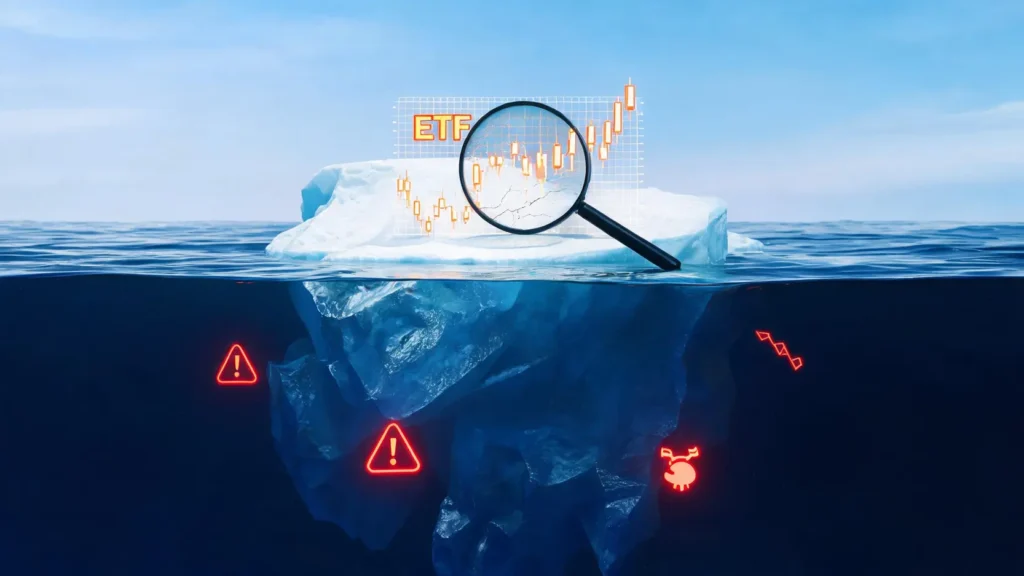
While Exchange-Traded Funds (ETFs) offer a straightforward and cost-effective method to diversify a portfolio, many market participants mistakenly assume they are entirely foolproof. The prevailing narrative often highlights their benefits while glossing over the inherent complexities. However, understanding etfs risk is absolutely essential for long-term financial success. As we navigate through the macroeconomic environment of 2026, characterized by shifting monetary easing policies and persistent market volatility, unpacking these hidden dangers becomes more critical than ever. This comprehensive guide will dissect the multifaceted risks associated with ETF investing—from broad market volatility to the intricate structural nuances of synthetic funds—equipping investors with the knowledge required to safeguard their capital.
Table of Contents
What Are the Primary Risks of Investing in ETFs?
Exchange-Traded Funds are investment instruments designed to track the performance of a specific index, commodity, or basket of assets. Despite their structural advantages, they are not immune to the fundamental forces that drive financial markets. Investors must recognize that buying an ETF means assuming the risks associated with its underlying assets.
Market Risk: The Unavoidable Reality of Investing
Market risk, often referred to as systematic risk, represents the potential for an investor to experience losses due to factors that affect the overall performance of the financial markets. When you invest in an equity ETF, you are directly exposed to the fluctuations of the stock market. If a major macroeconomic event—such as unexpected changes in interest rates or geopolitical tensions—triggers a broad market sell-off, the value of the ETF will inevitably decline in tandem with its underlying index.
In 2026, the transition across various economic cycles continues to demonstrate that diversification does not entirely eliminate market risk. For instance, an S&P 500 ETF provides exposure to 500 large-cap companies, significantly reducing the idiosyncratic risk of a single corporate failure. However, if the entire US equity market enters a bearish phase, the ETF’s net asset value (NAV) will drop. Investors must align their asset allocation strategies with their risk tolerance, recognizing that broad market exposure guarantees participation in both market rallies and severe downturns.
Liquidity Risk & Bid-Ask Spreads Explained
Liquidity risk in the context of ETFs manifests in two distinct layers: the liquidity of the ETF shares traded on the exchange and the liquidity of the underlying assets held within the fund’s portfolio. While heavily traded funds like those tracking major indices boast deep liquidity, niche or thematic ETFs may suffer from thin trading volumes.
When an ETF has low trading volume, investors face a wider bid-ask spread—the difference between the highest price a buyer is willing to pay and the lowest price a seller is willing to accept. A wide spread acts as a hidden transaction cost, eroding potential returns. Furthermore, if the underlying assets, such as high-yield corporate bonds or emerging market equities, experience a liquidity shock, the Authorized Participants (APs) responsible for creating and redeeming ETF shares may struggle to execute trades efficiently. This disruption can cause the ETF’s market price to deviate significantly from its actual Net Asset Value, forcing investors to sell at a steep discount during times of market stress.
Structural and Hidden ETF Risks You Shouldn’t Ignore
Beyond the transparent market and liquidity risks, ETF investing carries structural vulnerabilities that are often overlooked by retail investors. These hidden risks stem from how the funds are constructed, managed, and weighted.
Concentration Risk: The Illusion of True Diversification
A common misconception regarding ETFs is that they inherently provide robust diversification. However, many market-capitalization-weighted indices are heavily skewed toward a handful of mega-cap corporations. By 2026, the dominance of the technology sector within global indices has reached unprecedented levels. Consequently, an investor purchasing a broad market ETF might unknowingly allocate a massive percentage of their capital to just five or six companies.
This concentration risk means that the performance of the entire fund is disproportionately reliant on the earnings and market sentiment surrounding a few dominant entities. If regulatory crackdowns or sector-specific headwinds impact these top holdings, the broader ETF will suffer significant drawdowns. Investors must scrutinize the weighting methodology of their chosen ETFs, perhaps considering equal-weighted alternatives to mitigate excessive exposure to top-heavy sectors.
Tracking Error: Why Your ETF Might Lag Behind the Index
An ETF is designed to mirror the performance of its benchmark index, but it rarely does so with absolute perfection. The divergence between the fund’s actual return and the index’s return is known as tracking error. This discrepancy arises from several unavoidable operational realities.
Firstly, the management fees and administrative expenses (Total Expense Ratio) naturally drag down the fund’s net performance over time. Secondly, portfolio managers must execute rebalancing trades to reflect changes in the index composition, incurring transaction costs and potential market impact. Additionally, cash drag—where a fund holds a small portion of uninvested cash for operational purposes—can cause the ETF to underperform during strong bull markets. Over an extended investment horizon, a persistently high tracking error can result in a noticeable shortfall in projected wealth accumulation, making it imperative for investors to evaluate historical tracking precision when selecting an ETF.
The Danger Zones & Risk Mitigation Strategies
While traditional physical ETFs carry manageable risks, the landscape of investment instruments includes complex derivatives-based products that introduce entirely new dimensions of volatility and structural peril.
Counterparty Risk in Synthetic, Leveraged, and Inverse ETFs
Unlike physical ETFs that hold the actual underlying securities, synthetic ETFs rely on derivative contracts—such as total return swaps—entered into with investment banks to replicate index performance. This structure introduces counterparty risk: the possibility that the financial institution providing the swap defaults on its obligations. Although robust regulatory frameworks mandate strict collateral requirements to mitigate this risk, the threat remains non-zero during severe systemic financial crises.
Furthermore, leveraged and inverse ETFs utilize complex financial engineering to amplify daily index returns or profit from market declines. Due to the compounding effect of daily resetting, the long-term performance of these products will almost certainly deviate drastically from the underlying index’s return over the same period. This phenomenon, known as volatility decay, makes leveraged ETFs highly unsuitable for buy-and-hold strategies. They are tactical trading instruments that require precise timing and constant monitoring.
ETF Closure Risk: What Happens When an ETF Shuts Down?
The rapid proliferation of highly specific, thematic ETFs has led to a saturated market. When an ETF fails to attract sufficient Assets Under Management (AUM) to remain commercially viable, the fund sponsor will likely liquidate it. In 2026, the pace of ETF closures highlights the importance of viability assessment.
When an ETF closes, the fund manager liquidates the underlying assets and distributes the cash proceeds to shareholders based on the final NAV. While investors do not simply lose their capital, this forced liquidation can trigger unexpected capital gains tax liabilities and force investors to reinvest their funds during potentially unfavorable market conditions. To minimize ETF closure risk, market participants should generally favor funds that have established a substantial AUM base—typically over $50 million—and demonstrate consistent trading volume.
Actionable Framework: How to Evaluate and Mitigate Risks Before Buying
Prudent portfolio management requires a structured approach to assessing etfs risk. Before committing capital to any exchange-traded product, investors should apply a rigorous evaluation framework:
- Analyze the Underlying Index: Understand exactly what the ETF tracks. Review the top ten holdings to identify potential concentration risk and assess the fundamental quality of the assets.
- Evaluate Total Costs: Look beyond the Total Expense Ratio (TER). Consider the average bid-ask spread and historical tracking error to determine the true cost of ownership.
- Check AUM and Liquidity Metrics: Ensure the fund has sufficient Assets Under Management to mitigate closure risk and adequate daily trading volume to facilitate seamless entry and exit without severe slippage.
- Understand the Replication Structure: Verify whether the ETF physically holds the assets or uses synthetic derivatives. If synthetic, assess the quality of the collateral backing the swaps.
By systematically applying these criteria, investors can construct resilient portfolios that maximize risk-adjusted returns while avoiding common structural pitfalls.
FAQ on ETF Risks
Are ETFs generally riskier than individual stocks?
Generally, ETFs are less risky than individual stocks due to their inherent diversification. Holding a single stock exposes an investor to company-specific (idiosyncratic) risk, such as poor management decisions or bankruptcy. A broad-market ETF spreads this risk across hundreds of companies. However, this does not eliminate market risk, and highly concentrated thematic ETFs can approach the volatility levels of individual equities.
Can an ETF completely lose its value and go to zero?
While mathematically possible, it is highly improbable for a broad-market physical ETF to drop to zero, as that would require all underlying companies in the index to simultaneously go bankrupt. However, leveraged ETFs, inverse ETFs, or highly speculative thematic funds heavily reliant on volatile derivatives carry a significantly higher risk of experiencing catastrophic capital destruction during extreme market events.
What happens to my money if the ETF provider goes bankrupt?
If the asset management firm issuing the ETF declares bankruptcy, the investors’ assets remain secure. The underlying securities held by the ETF are custodied separately from the provider’s corporate assets by an independent custodian bank. In the event of a provider’s insolvency, a new manager would typically take over the fund’s administration, or the fund would be orderly liquidated, and the net asset value distributed to the shareholders.
Summary
Navigating the complexities of the modern financial landscape requires a clear understanding of the investment instruments at your disposal. While Exchange-Traded Funds are powerful vehicles for capital allocation, ignoring etfs risk can severely compromise portfolio stability. By rigorously analyzing liquidity profiles, scrutinizing index methodologies to prevent over-concentration, and grasping the structural nuances of derivative-based funds, investors can effectively mitigate downside exposure. Continuous due diligence and a disciplined adherence to fundamental risk management principles are paramount for achieving long-term financial resilience.